
Create Your Team Charter
Last week’s newsletter was about why your team needs a Charter. This week we dive deeper into each section, offering examples of each part to help your team start developing one.
Think of your charter as the structured design work that every high-performing team does before they step onto the field. It is the intentional preparation that allows a group of talented leaders to operate as a unified team instead of a collection of individuals. In the absence of a charter, leadership teams default to improvisation. People rely on personal style rather than shared agreements.
A Team Charter establishes the shared foundation that teamship requires. It aligns the team on why they exist, how they show up for one another, the systems that guide their collaboration, the frameworks that inform their thinking, and the practices that keep them aligned over time.
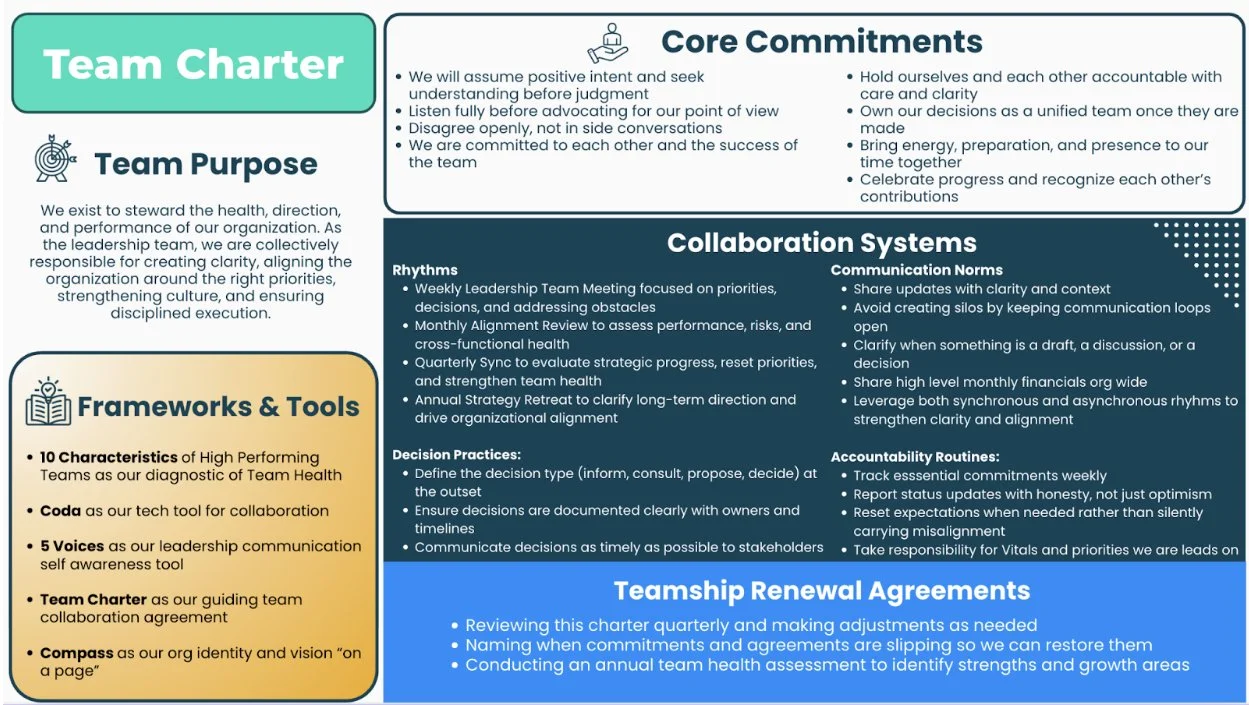
Start with Team Purpose
Every great team begins by answering two questions with absolute clarity. Why do we exist and what are we collectively responsible for? Team Purpose shouldn't be confused with the mission of the broader organization. It is the unique contribution this team makes to the health and performance of the whole organization.
Example:
We exist to steward organizational health, strategy, and direction. We are responsible for ensuring clarity of focus, supporting high-performing teams, and creating the conditions where our people can thrive.
A strong purpose statement brings shape to the team’s work. It clarifies what only this team can own and sets the boundaries for what it is and is not responsible for.
Core Commitments: How Will We Show Up for One Another
Commitments define the way teammates approach the work together. This section names the mindsets and behaviors that the team believes will create trust, accountability and psychological safety. It clarifies the relational norms that support healthy teamship.
Example commitments:
Hold ourselves and each other accountable with care and clarity
Own our decisions as a unified team once they are made
Disagree openly, not in side conversations
Bring energy, preparation, and presence to our time together
Celebrate progress and recognize each other’s contributions
These commitments function like a team’s shared culture code. They define what “great leadership here” looks and feels like.
Collaboration Systems: How the Work Actually Gets Done
This is where improvisation stops and intentional teamship begins. Your Collaboration Systems define how you operate together through rhythms, decision practices, communication norms, and accountability structures. Without this section, even the best commitments risk not being activated.
Here are some example systems and norms. Please note, teams should have more than these, but these three categories are a great place to start.
Core Rhythms
Weekly Leadership Team Meeting focused on priorities, decisions, and addressing obstacles
Monthly Alignment Review to assess performance, risks, and cross-functional health
Quarterly Sync to evaluate strategic progress, reset priorities, and strengthen team health
Annual Strategy Retreat to clarify long-term direction and drive organizational alignment
Communication Norms
Share updates with clarity and context
Avoid creating silos by keeping communication loops open
Clarify when something is a draft, a discussion, or a decision
Share high level monthly financials org wide
Leverage both synchronous and asynchronous rhythms to strengthen clarity and alignment
Decision Agreements
Define the decision type (inform, consult, propose, decide) at the outset
Ensure decisions are documented clearly with owners and timelines
Communicate decisions as timely as possible to stakeholders
Frameworks and Tools: The Shared Mental Models
Every strong team needs a common language that shapes how they interpret leadership, performance, and organizational health. Frameworks and common language speed up the efficiency of collaboration. This section captures the frameworks and tools your team uses to stay aligned. When people share mental models, they move faster and with far less friction.
Examples:
10 Characteristics of High Performing Teams as our diagnostic of Team Health
Coda as our tech tool for collaboration
5 Voices as our leadership communication self awareness tool
Team Charter as our guiding team collaboration agreement
Compass as our org identity and vision “on a page”
Teamship Renewal: Keeping the Charter Alive
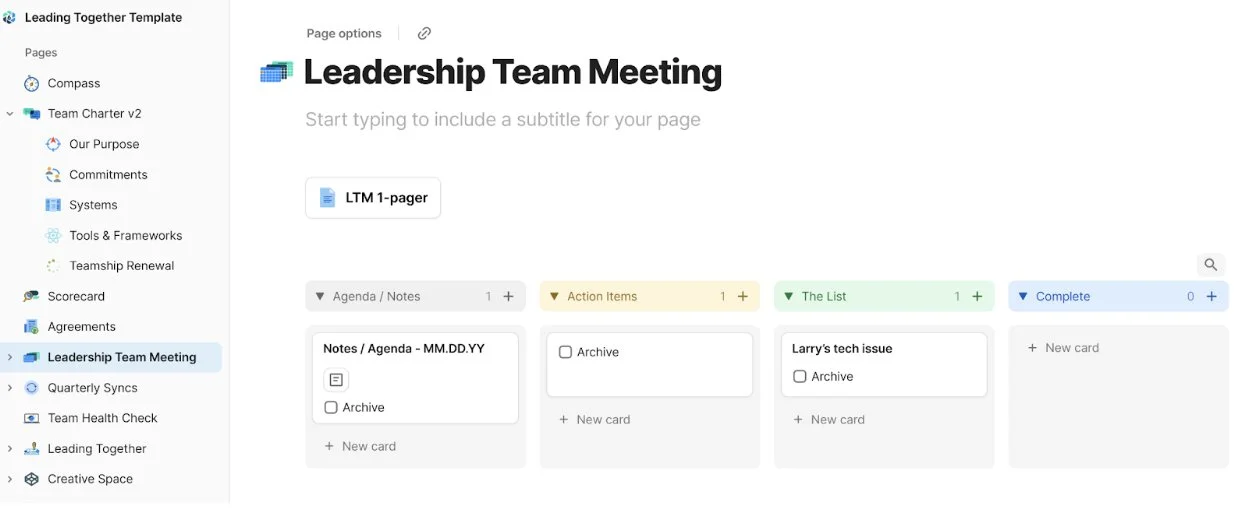
The Charter is not a document that gets laminated and forgotten. It is a living set of agreements that must be reviewed, reinforced, and refined over time. Even though we show a nicely formatted template above, ideally it lives in a collaborative tech tool like Coda or Notion that you can revisit and easily update often. This section outlines the ways you agree to keep the charter alive in practice.
Examples:
• Reviewing sections quarterly during a structured reflection
• Updating commitments when behaviors drift or expectations shift
• Revisiting the Team Purpose annually to ensure it reflects current reality
• Naming when the team is out of alignment and using the charter as a reset tool
Final Word
Just like a pro sports team that refines its playbook every season, leadership teams must return to their charter again and again. It is not about crafting a perfect document. It is about building shared clarity that strengthens over time. With a strong charter in place, the team no longer improvises its way through the work. You begin to anticipate each other’s moves, respond as a unit, and lead with a clarity that ripples across the entire organization. It is the shift from backyard football to coordinated teamship, and it begins with designing it together.
P.S. If you want help developing your Team Charter, simply respond to this email and let us know. Our Leading Together program guides teams through developing one.
-Shaun & Joe