
From Annual Goals to Real Progress
One of the most encouraging things we see at the beginning of each year is leadership teams doing the hard work of clarifying their shared focus. They step back and they commit to a small set of strategic objectives that will guide the year ahead.
And then something predictable happens. The calendar fills up and urgent issues take center stage. Meetings become reactive. And without meaning to, teams drift away from the very goals they worked so hard to define.
This is not a failure of commitment. It is a failure of intentional rhythm design.
In At the Heart of Work, we describe Rhythm as the leadership team’s ability to create consistent, intentional meeting cadences that keep focus alive over time. Focus sets direction. Rhythm sustains it. Without rhythm, even the clearest annual goals slowly lose their gravitational pull.
High-performing leadership teams understand this. They do not rely on memory, good intentions, or heroic effort to make progress. They build rhythms that continually pull the team back to what matters most.
Two meetings, in particular, do the heavy lifting.
The Quarterly Sync
Where Teams Learn, Reset, and Recommit
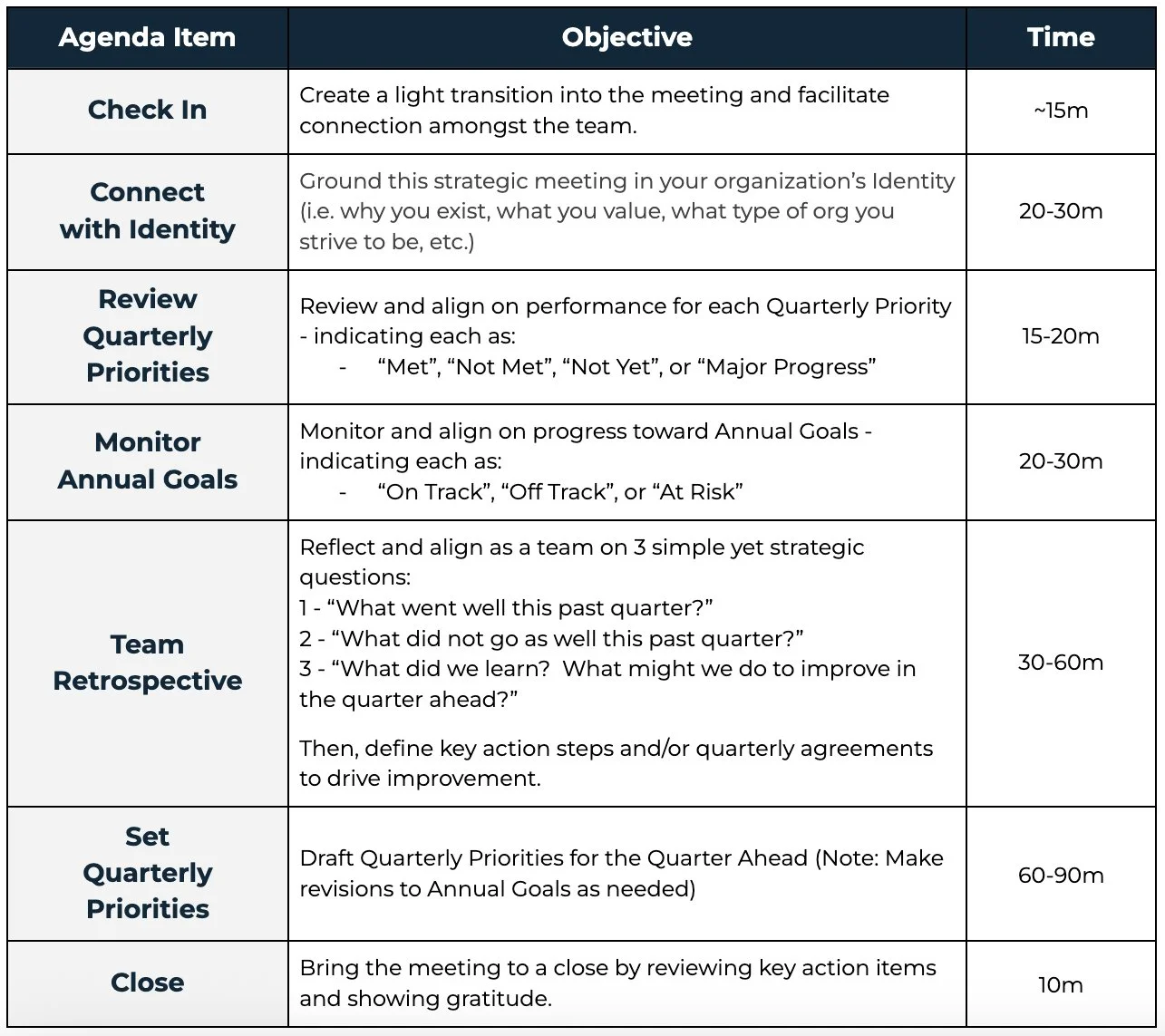
The Quarterly Sync is the strategic heartbeat that connects your annual goals to your next set of priorities. Its primary role is to ensure you aren't planning alone. It centers learning and improving as a team.
This important rhythm creates space for the leadership team to:
Review progress on quarterly priorities and annual goals
Reflect honestly on what worked and what did not
Surface patterns, obstacles, and blind spots
Translate learning into sharper focus for the quarter ahead
The most overlooked value of the Quarterly Sync is the retrospective. Teams slow down long enough to ask three deceptively simple questions: What went well? What did not go well? What did we learn?
That learning is what fuels better focus for the next quarter. But, to be clear, retrospectives result in so much more than just better priorities. If members of the team bring vulnerability and challenge to each other as they look back, they will become more connected and trust will deepen. There are few things teams can do to make progress automatically, but we can almost guarantee it if you simply book 4 quarterly syncs for 2026 and pair it with an agreement that they are sacred times to learn and plan together as a team.
Quarterly Sync Agenda
The Weekly Leadership Team Meeting
Where Focus Is Protected and Adjusted in Real Time
If the Quarterly Sync sets the direction, the Weekly Leadership Team Meeting keeps the team oriented.
This meeting is not primarily about updates. It is about alignment and problem solving.
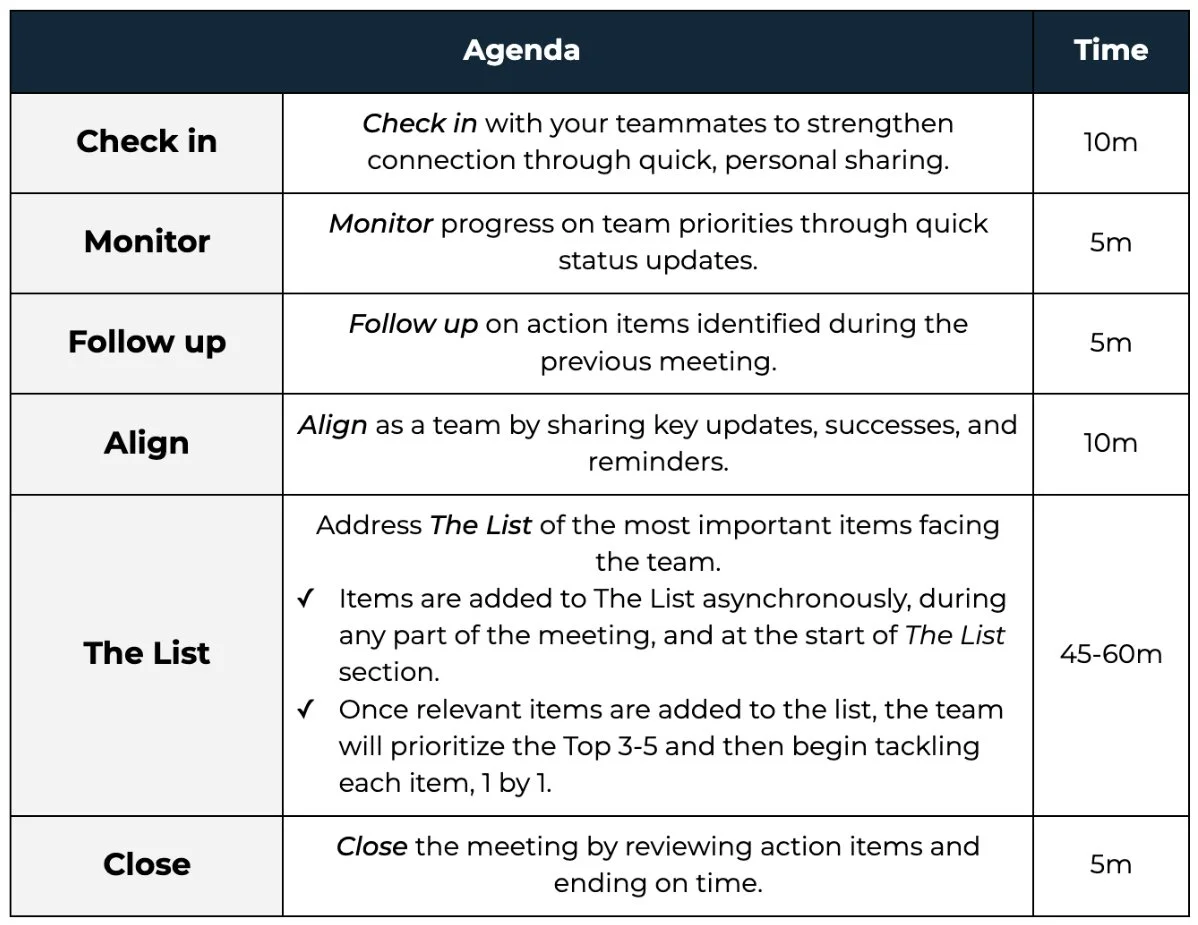
Each week, the leadership team comes together to:
Monitor progress on quarterly priorities
Follow up on commitments and decisions
Address emerging issues that threaten focus
Make real-time adjustments together
One of the most powerful elements of this meeting is “The List.” Instead of letting important issues spill into side conversations or one-on-ones, teams surface them publicly, prioritize together, and work through them as a unit.
This is where annual goals stay alive. Not because they are referenced ceremonially, but because weekly conversations are explicitly anchored to them. Progress is visible. Drift is noticed early and trade-offs are made together, not in silos.
Without this rhythm teams often discover too late that they have accidentally slipped into reactive ways of working, and their most important priorities are missed.
Weekly Leadership Team Meeting Agenda
Why These Two Rhythms Work Together
Neither of these meetings is sufficient on its own. Without a strong weekly rhythm, the Quarterly Sync can feel inspiring, but that excitement will fade when plans aren’t executed.
The Weekly Leadership Team Meeting without a Quarterly Sync becomes tactical. Efficient, but not connected to strategic direction.
Together, they form a flywheel:
The Quarterly Sync clarifies what matters most next
The Weekly Meeting protects and advances that focus
Learning feeds refinement
Refinement sharpens focus and that focus drives results
This is how leadership teams move from setting annual goals to actually achieving them.
A Closing Thought
Annual focus is not sustained by motivation. It is sustained by design.
If your leadership team has done the hard work of clarifying its shared priorities for the year, the next step is simple, though not easy: install and commit to the rhythms that will carry that clarity forward.
A handful of well-designed meetings, practiced consistently, can mean the difference between another year of good intentions and a year of meaningful progress.
-Shaun & Joe