
The Hidden Strength of the Canopy
Last summer our family spent a week on Vancouver Island. We took several hikes through old-growth rain forests, and the thing that struck me most wasn’t the size of the trees.
It was the canopy.
I don’t know that I’d ever been in a forest with such dense, connected coverage. At times there didn’t seem to be much light coming through, and yet the forest below was incredibly lush - even more vibrant than rainforests I’ve hiked in Costa Rica.
That felt counterintuitive and made me curious.
A bit of reading revealed just how much work the canopy is doing, quietly and consistently:
It regulates temperature, protecting everything below from extremes
It manages moisture, slowing rainfall and reducing erosion
It filters light so growth underneath is steady, not scorched
It creates stability, allowing diverse life to thrive together
In other words, the canopy plays a significant role in creating the conditions that make the growth possible. Once I saw that, I couldn’t unsee the parallel to leadership teams.

The Unseen Conditions That Drive Performance
Most teams spend their time trying to improve performance without zooming out far enough to examine what’s actually shaping it. They focus on individual performance or the problems that feel the most urgent, while overlooking the conditions that influence how the team works.
As a result leaders end up investing in things like new technology, strategic planning and org restructuring. Because they are easier to see, it feels easier to prioritize them. Team dynamics, on the other hand, often feel more abstract and harder to get our heads around. As a result leaders invest considerably less in it.
These three areas are hard to see, but just like a canopy, significantly influence a team’s performance.
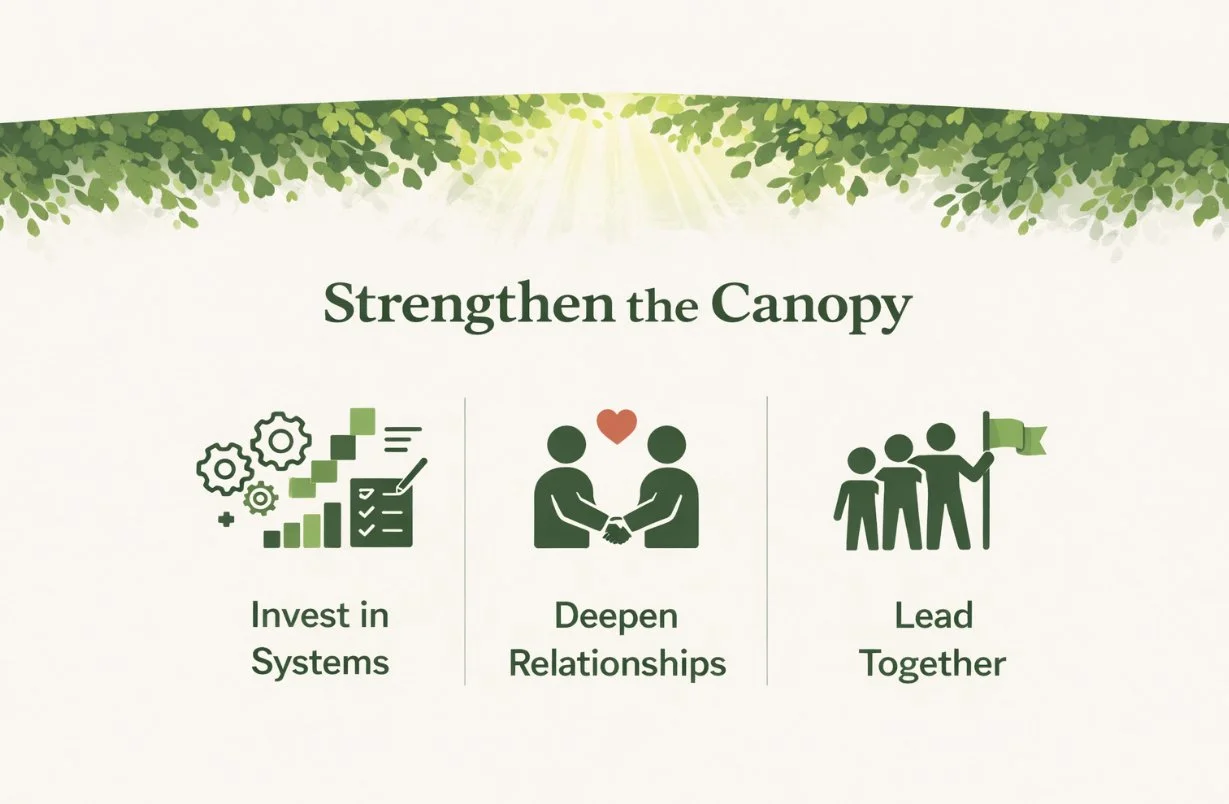
1. The Systems a Team Operates Within:
Every team is shaped by the systems that guide its work. The problem for most teams is that the systems they operate within largely exist accidentally. Meaning they were inherited, or created without adequate discussion and agreement. And yet it's these very systems that shape our experience of work as much as anything. If you don’t believe us, just think about that one recurring meeting that you dread going to. They include systems like the following:
Priority setting process
Decision-making agreements
Meeting agendas
Strategic Planning framework
Clarifying the systems we work within goes a long way towards creating the conditions for teams to thrive. The good news is that you can make progress a bit at a time, choosing to improve each system one at a time if your capacity feels limited.
2. The Strength of the Relationships:
Performance is also shaped by how people experience working together. Even teams with inspiring strategic plans and sparkling scorecards will struggle significantly if they aren't tending to the quality of the relationships within the team.
Do team members feel safe speaking honestly?
Is feedback shared directly and constructively?
Can tension be surfaced and worked through productively?
Do people trust one another’s intentions?
When these dynamics are strong, collaboration becomes easier and more resilient. When they’re strained or avoided, progress slows and energy drains. Teams should regularly work to strengthen their relationships amongst each other. Many times that will require learning and practicing new skills, such as how to give good feedback, and how to practice reflective listening for example.
3. Leading Together
Perhaps most important is whether a team takes shared responsibility for improving how it works together. Healthy teams don’t leave their environment to chance. They periodically step back to examine what’s helping or hindering their effectiveness and make deliberate adjustments. This work can’t be owned by one person alone. It requires a collective commitment to shaping the systems and interpersonal dynamics that influence performance every day. This requires a shift to a teamship mindset, where teams collectively embrace a shared goal to lead as a unit, rooted in the belief that they can achieve more when they lead together than when any one person carries too much weight.
The Role Leaders Play in Shaping Conditions
Wherever a leadership team exists, whether at the executive level, within a division, or leading a program, it plays a meaningful role in shaping these conditions. Not because leaders control every outcome, but because they influence the systems, relationships, and norms that determine how work happens every day.
When leaders invest in strengthening these areas, they are not just improving teamwork. They are shaping the environment that makes strong performance more likely. This work is often subtle. It doesn’t always produce immediate or highly visible results. But over time, it has a compounding effect on how a team functions and what it is able to achieve.
A Final Thought
Many of the most important drivers of team health are the most difficult to see. In fact many times they seem invisible. Like the canopy in a forest, the conditions surrounding a team often go unnoticed until we begin to look for them. The good news is that once you start to bring attention to them, they become easier to see. By intentionally strengthening team systems and dynamics, people skills and relationships, and committing to lead together, leaders help create the environment where strong performance can take root and grow.
-Shaun & Joe