
Four Thousand Weeks
If you live to be 80 years old, you'll have lived roughly 4,000 weeks.
That's the premise behind Oliver Burkeman's book, Four Thousand Weeks: Time Management for Mortals.
Four thousand weeks doesn't seem like very many when you consider everything we hope to experience and accomplish during our lives.
It feels even more sobering when you consider how much time you spend responding to emails, sitting in meetings, and attending to whatever happens to demand your attention. We end the week exhausted, and wondering if we moved anything significant forward.
Meanwhile, the things we say are most important keep getting pushed to next week. At work, it's the strategic thinking, the investment in our people, or the difficult conversation we've been putting off. At home, it might be time with our spouse, being present with our kids, or investing in relationships that matter to us.
Burkeman's point isn't that we need to become more efficient so we can squeeze more into our 4,000 weeks. It's that we need to accept that we can't do everything, and become more intentional about what we choose to do.
Which brings me to something we see all the time in our work with leadership teams.
Too often, we allow the urgency of what's in front of us to determine what deserves our attention. But what if some of that urgency isn't actually real?

The Illusion of Getting Time Back
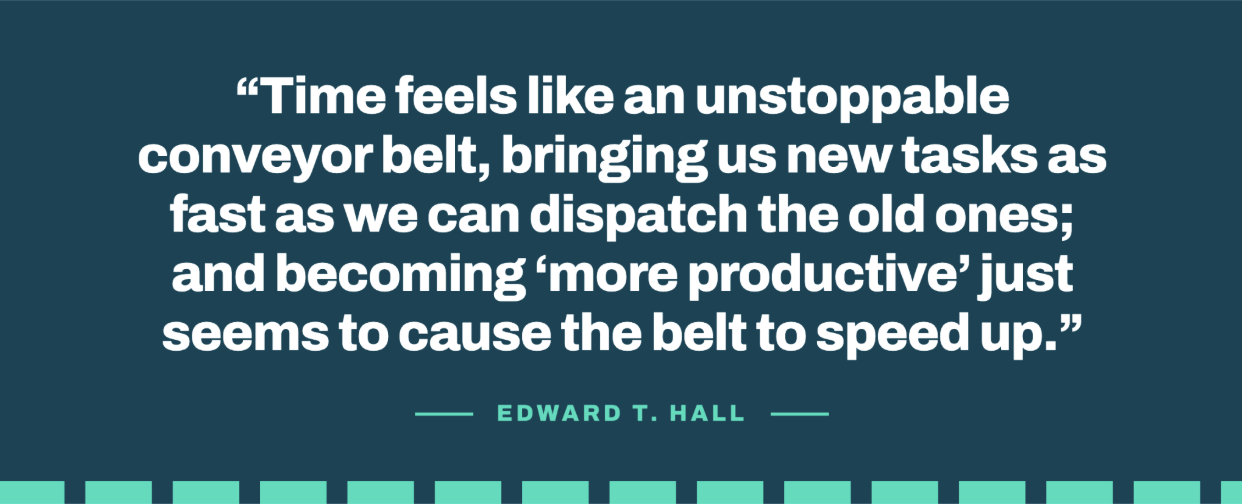
We're constantly searching for the next productivity hack, time-saving tool, or system that will help us work more efficiently. Somewhere in the back of our minds is the belief that if we can just get better at managing all the things demanding our attention, we'll finally have more time for the things that matter.
But how often has that actually worked?
Think about the tools and systems you've adopted over the years to save time. Has the time you've saved translated into more space for strategic thinking, meaningful relationships, or the things you care most about? Or has it simply created more capacity to take on even more of that very same type of work? Perhaps you got a bit more time for strategic work, but I suspect for most of us, it didn’t achieve what we were hoping it would.
We become more efficient at responding to the demands on our time without ever questioning whether those demands deserve our attention in the first place.
Maybe the answer isn't figuring out how to get more done. Maybe it's getting better at deciding what doesn't need to be done right now, or at all.
And that starts with recognizing that not everything that feels urgent actually is.
Not All Urgency Is Created Equal
One of the keys to finding more time to work on truly important work is being able to recognize that there are different kinds of urgency that we will confront.
Real urgency exists when something meaningful will be lost, harmed, or made substantially worse if we don't act quickly. A serious safety concern, a critical service disruption, an immediate financial threat, or significant harm to team trust would fall into this category.
Manufactured urgency exists when something feels time-sensitive, but the consequences of waiting are relatively minor. Maybe someone wants an answer today simply because that's when they asked for it. Maybe a deadline was established without much thought about when it actually needed to get done. Or maybe we're just uncomfortable knowing someone is waiting on us.
Preventable urgency is different. The consequences of waiting may be real, but the situation became urgent because something wasn't addressed earlier. A staffing crisis because succession planning was postponed. A major conflict that grew out of conversations no one wanted to have. A last-minute scramble because expectations weren't clear.
These distinctions matter because each calls for a different response.
Real urgency requires action. Manufactured urgency requires discernment and pushing the deadline back. Preventable urgency requires us to address the immediate issue while also learning what allowed it to become urgent in the first place.
Three Questions Worth Asking
So how do we get better at distinguishing what's truly urgent from what only feels urgent?
1. What actually happens if this waits?
When something demands our attention, consider what the real consequence would be if we addressed it tomorrow, next week, or at our next scheduled meeting. Sometimes the urgency is obvious. Other times, we discover that the greatest consequence is simply that someone will have to wait. And that's not always a bad thing.
2. Does this require my attention, or just someone's attention?
Something can be genuinely urgent without requiring you to resolve it. We see this frequently in organizations where leaders have become the default problem-solvers. People bring issues to them because they know they'll get an answer, and leaders respond because they want to be helpful.
Over time, this creates dependency. Decisions get pushed upward, leaders become bottlenecks, and the people closest to the work have fewer opportunities to exercise their own judgment. Sometimes the best response isn't to solve the problem, but to empower someone else to do so.
3. Why has this become urgent?
When we encounter a recurring emergency, it's worth examining what's creating it. Is there a planning issue? An unclear decision-making process? A lack of accountability? A conversation we've been avoiding. If we only resolve the immediate issue, there's a good chance we'll be dealing with something similar again.
A Final Thought
The solution isn't to become less responsive to people or pretend genuine emergencies don't exist. Leadership requires us to respond to unexpected challenges, and sometimes that means setting aside our plans. But we need to become more intentional about what earns the right to interrupt those plans.
That might mean clarifying when something actually needs to be completed, empowering others to make decisions, or protecting time for strategic priorities with the same discipline we bring to urgent requests.
One of the biggest challenges is that the work that matters most won't always be the work that demands our attention most loudly. Developing a leader rarely feels as urgent as answering an email. Strengthening a relationship doesn't usually come with a deadline. Improving an organizational system can almost always be pushed to next week. But that doesn't make those things less important.
Most of us only get 4,000 weeks. We have more influence over how we live them than most of us realize.
-Shaun & Joe