
Teams Increase Engagement When People Believe Their Voice Matters
We often assume people aren't speaking up because they don't feel safe. We assume people are afraid of being judged, criticized, creating conflict, or damaging relationships – in other words, we assume that team psychological safety isn’t strong enough.
And while that certainly happens, research suggests there may be another reason that is even more common. People stop speaking up when they no longer believe their input will lead to meaningful change.
Think about what happens when someone raises a concern, offers an idea, or identifies an opportunity for improvement. If nothing happens once, it's disappointing. If nothing happens repeatedly, people begin learning a different lesson. They start to question whether their effort is worth it. Over time, they conclude that speaking up simply doesn't make a difference.
Eventually, they stop offering ideas altogether. Not because they don't care or because they have stopped noticing opportunities. But because they have lost confidence that their voice will influence much, if anything.
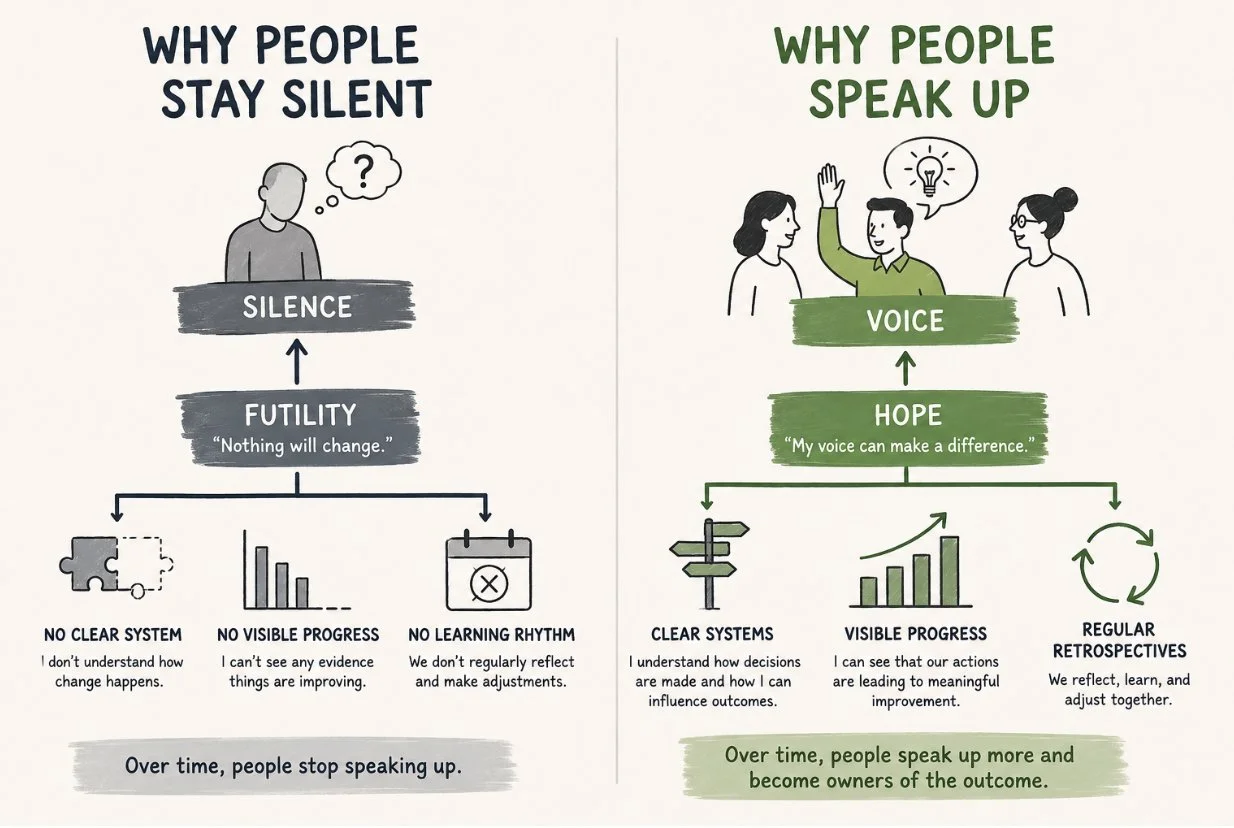
This is where many teams misdiagnose the problem. They assume silence is primarily a symptom of fear, when in reality it is often a symptom of futility. Team members have become convinced that the current reality is unlikely to change regardless of what they say or do. And once that belief takes hold, disengagement becomes surprisingly rational.
People Speak Up When They Believe Change Is Possible
Several months ago, we wrote about the science of hope. One of the most interesting findings from hope research is that hope is not simply optimism. True hope springs from more than the belief that a better future is possible. It also requires that people see a pathway to get there.
Researchers describe hope as the combination of three elements: goals, pathways, and agency. People need a meaningful destination they are working toward, a believable route for getting there, and confidence that their actions can influence the outcome.
The same principle applies to teams and their ability to believe that change is possible, or heck even likely.
When people cannot see where the team is headed, do not understand how change happens, or believe their contribution will have little impact, they naturally become less engaged. On the other hand, when team members can see progress, understand how decisions are made, and believe their voice matters, they become far more willing to contribute ideas and feedback. Here are three ways to create a culture where people believe speaking up, sharing ideas, and offering their best thinking is worth it.
Understanding How Change Happens
One reason people stop speaking up is because organizational change often feels mysterious. They do not know how priorities are established, who owns key decisions, or how ideas move from conversation to action. Over time, speaking up can begin to feel like dropping a suggestion into a black hole.
High-performing teams work hard to make the systems and agreements that drive change visible and well understood. They clarify how decisions are made, establish team norms, and create clear goals and measurable outcomes. Most importantly, they help people understand how they can influence the team's direction and performance.
When team members understand how the team operates, they can see where they can contribute and how their ideas might influence outcomes. People are far more likely to speak up when they understand how change happens and believe their voice can help shape it.
Progress Creates Belief
Another powerful way to restore hope is by helping people see progress. One of the reasons we spend so much time helping organizations establish Vitals and short-term priorities is because measurable progress is so motivating (See The Progress Principle by Steven Kramer and Teresa Amabile). When teams can see improvements in employee engagement, customer satisfaction, retention, quality, financial performance, or other key indicators, they begin to connect effort with outcomes.
Without visible progress, improvement feels abstract. People may be working hard, but they struggle to see whether their efforts are making a difference. Over time, that uncertainty can reinforce the belief that speaking up won't matter anyway.
Visible progress tells a different story. Every time a team identifies a problem, makes an adjustment, and sees meaningful movement, it reinforces a powerful message: our actions matter. When people can see that change is happening, they become more willing to engage in creating more of it.
Build Confidence Through Retrospectives
One of the most hopeful experiences a team can create is a regular retrospective. Not because every problem gets solved or every idea gets implemented, but because retrospectives demonstrate that the team is committed to learning and improving together. They provide evidence that feedback does not simply disappear once it is shared. Every retrospective reinforces this message: improvement is possible, and your voice can help create it.
When teams consistently pause to ask questions like, "What's working?", "What's not?", and "What should we adjust?", they communicate that improvement is possible and that team members have a role to play in creating it.
Many teams ask for feedback. Far fewer create consistent opportunities to act on it. Retrospectives create a rhythm where concerns can be raised, patterns identified, and improvements made together. Over time, team members begin to trust that what they see matters and that the challenges they raise today may become improvements tomorrow.
A Final Thought
Psychological safety is incredibly important. People need to feel comfortable speaking up before they will share concerns, challenge assumptions, or offer new ideas. But comfort alone is not enough. People also need to believe that speaking up is worth it.
The most effective teams create both. They build environments where people feel safe to contribute and confident that their contribution can influence what happens next.
When people believe change is possible, something remarkable happens. They stop acting like passengers and start acting like owners.
-Shaun & Joe