
Organizations Increase Innovation When Leaders Create the Right Conditions
Many organizations desire to be more innovative. They wish they had more people bringing forward new ideas, solving problems creatively, and finding better ways to serve customers and clients and advance the mission and strategic goals
It's usually not for a lack of good ideas. When teams struggle to bring new ideas to life, it's usually a conditions problem.
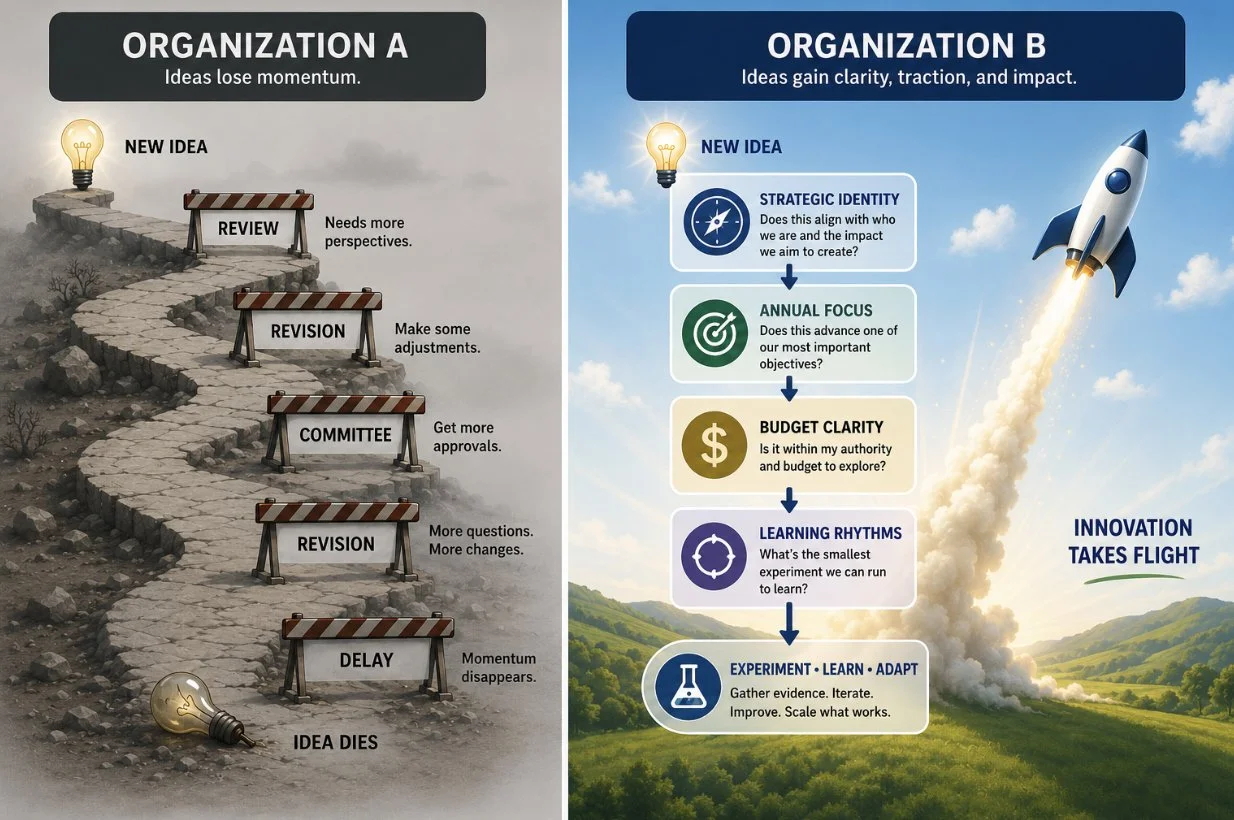
It usually goes something like this: someone identifies an opportunity and brings forward a new idea. The team likes it, but before moving forward they want a few additional perspectives. The idea gets adjusted and brought back. More questions emerge. More revisions are made. More approvals are needed.
By the time the idea finally gets a green light, it looks very little like what was originally envisioned. Once you've worked through all those hurdles the momentum has disappeared. And after experiencing this a few times, people begin telling themselves, what's the point.
Most organizations don't realize they've created conditions that unintentionally stifle innovation. They assume the answer is brainstorming sessions, innovation committees, or finding more creative people. In reality, innovation flourishes when the right conditions are present.
Condition #1: Team Psychological Safety
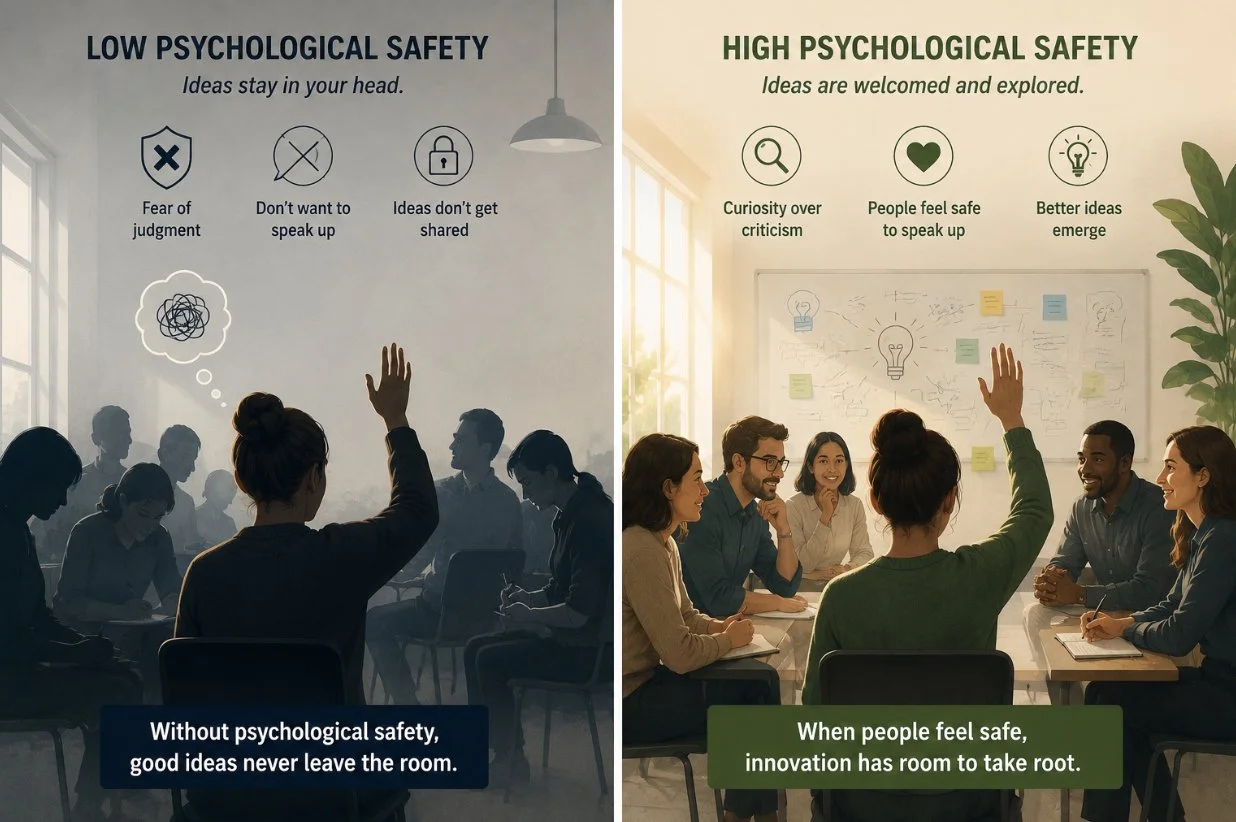
Before innovation can be evaluated, refined, or tested, it first has to be shared.
Many teams unintentionally create environments where people become reluctant to bring forward new ideas. Perhaps they've seen ideas dismissed too quickly, watched others get criticized for taking risks, or experienced a culture where questioning the status quo isn't welcomed. Over time, people begin filtering themselves before they ever speak up.
Innovation requires people to share half-formed ideas, challenge existing assumptions, and occasionally suggest something that doesn't work. That takes courage.
Teams that consistently innovate create environments where people feel safe enough to contribute their thinking before it is fully polished. They know not every idea will move forward, but they trust that ideas will be explored with curiosity rather than immediately judged or dismissed.
Without psychological safety, the best ideas often never leave people's heads.
Condition #2: Clear Strategic Identity
Innovation requires boundaries. People need to understand why the organization exists, how it creates impact, and what success looks like. Without that clarity, every idea feels equally important. Teams spend their time chasing opportunities without a clear way to evaluate which ones are worth pursuing.
This is where a clear Theory of Impact and a handful of meaningful Vitals become so important. A Theory of Impact is where strategy begins. It clarifies how an organization uniquely accomplishes its mission. It clarifies a unique approach that leverages the organization’s experience, strengths and deep convictions.
Clarifying the handful of Vital metrics that define measurable success is also critical. This communicates to everyone what the most important measurable results are. When meaningful targets are set for the most important Vitals, they will empower people to innovate in ways that help to achieve them.
Condition #3: Strong Annual Focus
Some of the best ideas can become distractions when team focus hasn’t been established. One of the biggest barriers to innovation is uncertainty around priorities. When people aren't clear on what the most important goals are for the year, they struggle to determine which ideas deserve their attention.
Clear annual priorities create focus. They allow people to ask a simple question: "Does this help advance one of our most important objectives?"
If the answer is yes, keep exploring. If the answer is no, perhaps it's a great idea for another season. Focus doesn't limit innovation, it directs it.
Condition #4: Budget Clarity
Many organizations unintentionally create innovation bottlenecks because people don't know where they have authority to spend. As a result, ideas spend months moving through approval processes, not because anyone is opposed to them, but because nobody is sure who can make the decision.
Leaders should understand what financial decisions they can make, what guardrails exist, and where additional approval is required. When people know where they have agency, experimentation becomes much easier.
Condition #5: Established Learning Rhythms
Innovation is not about a singular moment of brilliance. New products and services are usually established through a series of iterations and experiments.
When teams design intentional ways to reflect and stamp learning from each iteration, they greatly increase the odds of future iteration.
They create rhythms that allow teams to ask:
What did we try?
What did we learn?
What should we continue?
What should we adjust?
What should we stop doing?
Without learning rhythms, experimentation becomes random. With them, innovation compounds. Quarterly Syncs, retrospectives, and regular team reflection create space for small ideas to evolve into meaningful improvements over time.
A Simple Innovation Filter
When these conditions are in place, innovation becomes much more likely because people have a framework for evaluating ideas before they ever reach an approval process.
When considering a new idea, ask:
Does this support our strategic identity?
Does this advance one of our annual priorities?
Is it within my authority and budget to explore?
What is the smallest experiment I could run?
What evidence would help validate this idea?
Adopting a set of questions like this can really speed up the decision making process. Imagine talking to your team about your new idea and then knowing that you already considered these questions because your team has set a norm to do that. On the other hand, when a team hasn’t established an agreement like this, you will likely be wondering how the person came to the conclusion that their new idea is a good one.
A Final Thought
Most organizations assume innovation begins with a great idea. In reality, innovation begins with creating the conditions that allow good ideas to survive long enough to be tested.
When people understand the strategic identity, know the strategic priorities, have clarity about their authority, and are encouraged to experiment and learn, innovation becomes far less dependent on a few creative individuals.
-Shaun & Joe