
Is Your Team Building on Dysfunction
In Brené Brown’s new book, Strong Ground, she shares a lesson she learned while recovering from a sports injury. She was eager to get stronger and return to competing, but her trainer noticed a problem. Her body had learned to compensate for weaknesses in her core and alignment by relying on other muscles to do the work.
The trainer told her before she added more strength, she needed to address the dysfunction underneath it.
His message was simple: “We will not build on dysfunction.”
As I read this, I couldn’t help but think about executive team performance.
Most leadership teams want to get stronger and move faster. They want greater accountability, healthier conflict, better execution, and the ability to navigate increasingly complex challenges together.
But sometimes they’re trying to add strength to a team that hasn't yet built the foundation healthy enough to support it.

Executive Teams Compensate, Too
One of the interesting parts of Brown’s story is that her body was still functioning. She could move, exercise, and compete. Other muscles had simply learned to compensate for the areas that weren't working as they should.
Executive Teams do the same thing, and this is why it can be hard to diagnose the problem.
When priorities aren't clear, the CEO steps in and makes more decisions. When trust is low, difficult conversations happen outside the room instead of inside it. When accountability is weak, teams add more processes and reporting. When strategic direction isn't clear, individual leaders work harder within their own functions while the organization struggles to move together.
And for a while, those compensations can work. Hard work and strong willpower can cover up unclear systems… for a bit.
But eventually, those compensations and work-arounds become harder to sustain, especially as the organization grows, complexity increases, or new opportunities require more from the team. Then suddenly they fall-apart, and the team is left scrambling reactively instead of planning pro-actively.
What Is Strong Ground for an Executive Team?
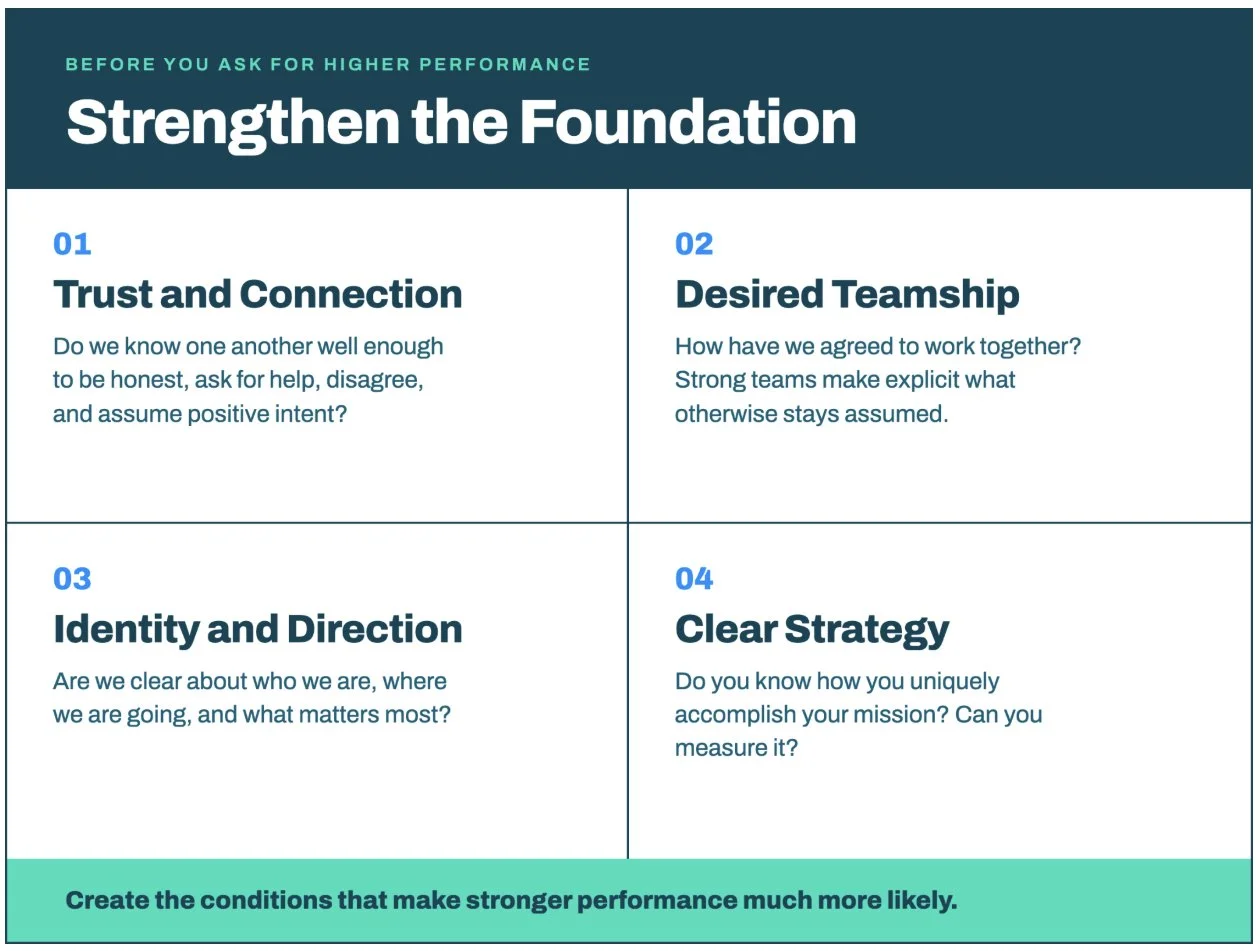
Before asking a team to perform at a higher level, we believe there are a few foundational things worth investing in
1. Trust and Connection: Do we know one another well enough to be honest, ask for help, disagree, give feedback, and assume positive intent? Without trust, almost every other aspect of team performance becomes harder.
2. Desired Teamship: How have we agreed to work together? What can we expect from one another? Strong teams make explicit the agreements that otherwise remain assumed.
3. Identity and Direction: Are we clear about who we are, where we're going, and what matters most? A shared Compass gives the team something bigger than individual functions or preferences to align around.
4. Clear Strategy: Do you know how you uniquely accomplish your mission? Do you have ways to measure it?
None of these things guarantee high performance, but they create the conditions that make high performance much more likely .
It's difficult to hold a peer accountable when you've never agreed on what you expect from one another. It's hard to have healthy conflict when trust is thin. It's nearly impossible to execute together when five executives have five different interpretations of where the organization is going.
But we don’t have time! (The Capacity Paradox)
There's a temptation to view this foundational work as something to tackle when things calm down. First we'll get through the growth, finish the reorg, or navigate the current challenge. Then we'll have more time to work on the team.
The problem is that most leadership teams never reach that season they are hoping for. There will always be another priority competing for their attention, and the very dysfunctions they're waiting to address are often consuming more time and energy than they realize.
When trust is stronger, teams spend less energy navigating around one another. When strategic direction is clear, fewer hours are lost debating priorities or pursuing work that doesn't matter most. When expectations are explicit, difficult conversations become easier to have. And when the team has shared ways of working, the CEO doesn't have to carry as much of the weight.
In that sense, investing in the foundation isn't something you do once you have more capacity. It's one of the ways you create more capacity.
A Final Thought
If your Executive Team is working harder but still struggling to make progress, the answer may not be to add more weight. It may be to look at the foundation underneath it.
Where is your team compensating for something that isn’t working as well as it should? And what would change if you strengthened that foundation instead?
Sometimes the best way to help a team move faster is to first make sure it has strong ground to push from.
-Shaun & Joe