
Leadership Teams Improve Performance When They Eliminate Unintentional Sabotage
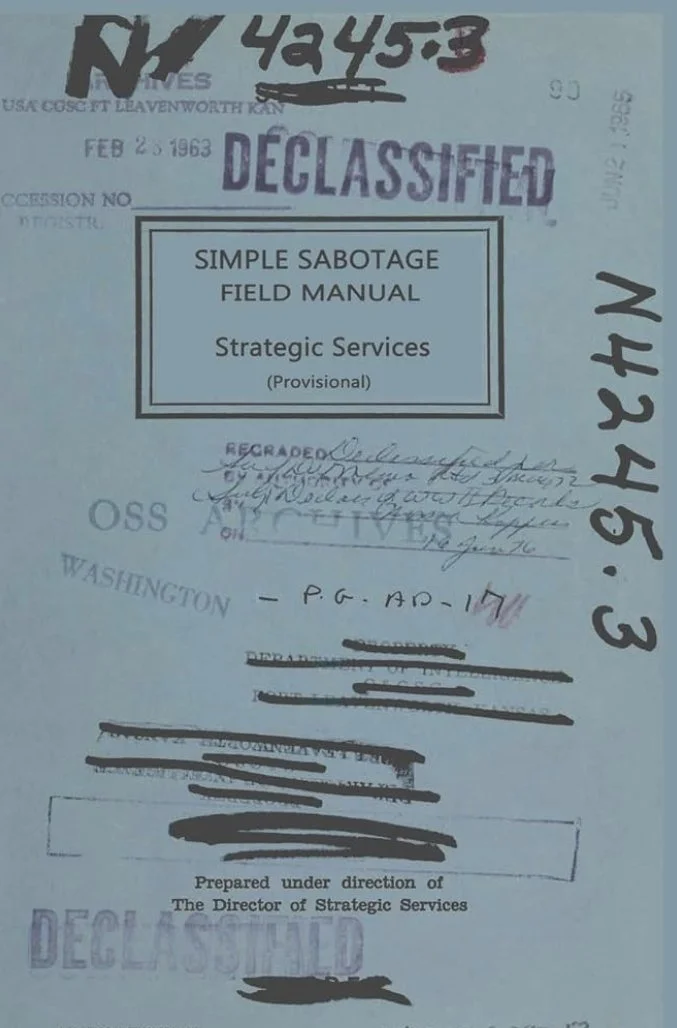
In 1944, the Office of Strategic Services, the precursor to the Central Intelligence Agency, published a document called the Simple Sabotage Field Manual.
It was not written for trained operatives, but for ordinary citizens living in enemy-controlled territories during World War II. The goal was to help everyday people disrupt organizations from the inside. Rather than relying on dramatic acts of destruction, the manual focused on small, consistent behaviors that would quietly reduce efficiency, create confusion, and weaken performance over time.
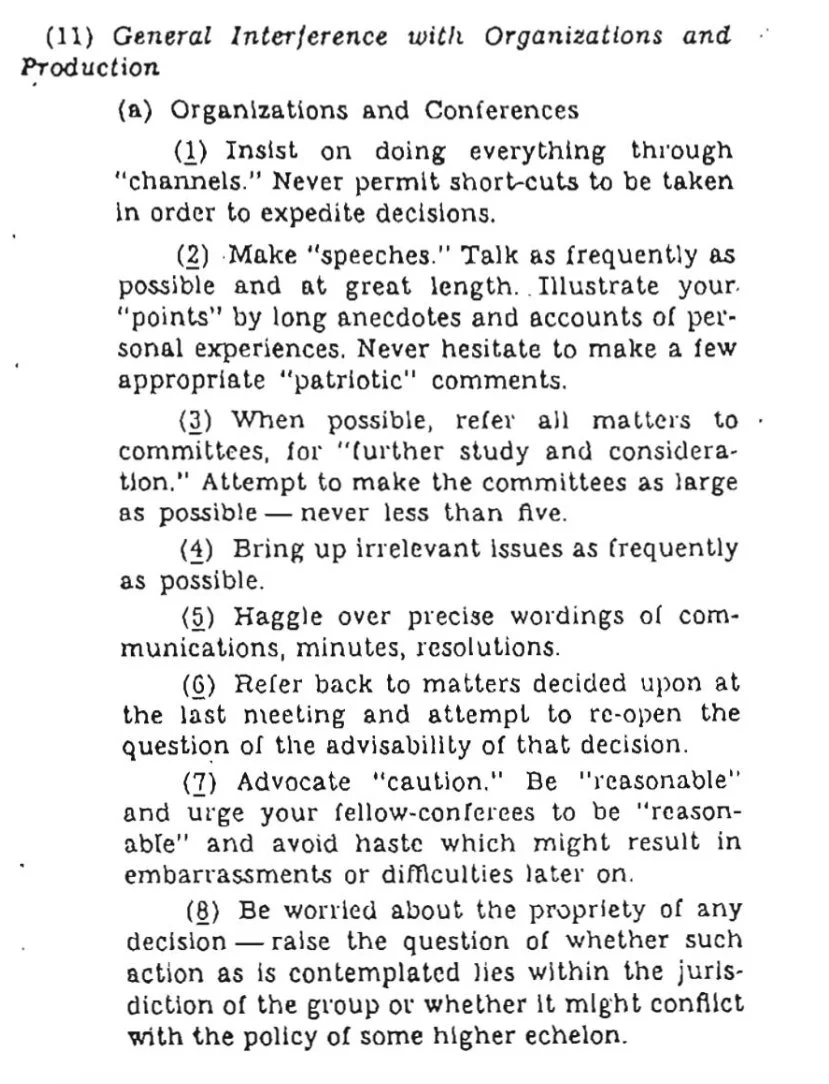
One directive from the manual captures this approach clearly:
“When possible, refer all matters to committees, for ‘further study and consideration.’ Attempt to make the committees as large as possible.”
What makes a line like this so striking is how familiar it feels. It is not dramatic. It is not obvious. It is the kind of behavior that, on the surface, appears reasonable. And yet, when repeated over time, it slows decisions, diffuses ownership, and makes progress more difficult than it needs to be.
The manual is filled with similar guidance. Insist on unnecessary approvals. Reopen decisions that have already been made. Focus on minor details instead of what matters most. Avoid clear ownership of work. None of these actions, on their own, would seem especially harmful. But taken together and repeated over time, they create friction, slow execution, and erode morale. The insight behind it has proven true time and again: small, everyday behaviors shape performance in significant and powerful ways.
Unintentional Sabotage
What is striking is how many of these same patterns show up inside teams today. Not because people are trying to sabotage their organizations, but because the default conditions of most workplaces tend to reward a very different set of behaviors than leaders intend. When ownership is unclear, incentives are misaligned, and decision processes are not well defined, teams often drift toward caution, complexity, and consensus rather than clarity, speed, and accountability.
In practice, this can look like pulling more people into decisions in an effort to ensure buy-in, delaying calls until there is full alignment, refining work well past the point of usefulness, or escalating decisions rather than taking ownership of them directly.
Over time, these behaviors do not feel like dysfunction. They often feel responsible. In the moment, they signal thoughtfulness, collaboration, and diligence. But collectively, they create drag. They slow execution, dilute ownership, and make it more difficult for teams to operate with the level of focus and momentum leaders are trying to achieve.
But There’s Hope…
The part of the field manual that is easy to overlook is not just how simple these behaviors are, but how intentional they were. Each action was designed to produce a specific outcome, and the cumulative effect was predictable because the inputs were deliberate.
This is where the parallel to leadership teams becomes more interesting. Many of the patterns that slow teams down today are not the result of bad intent, but of a lack of intentional design. Without clear agreements around how a team sets priorities, makes decisions, navigates conflict, and holds one another accountable, those same patterns begin to emerge on their own.
Which raises an important question. What would it look like to bring that same level of intention to how a team operates, but with a very different aim?
The Opposite of Sabotage
What if a leadership team became just as deliberate about how it works together, but with the goal of strengthening performance, increasing clarity, and building trust?
Instead of unintentionally slowing decisions, the team could define how decisions are made and who is responsible for making them.
Instead of allowing meetings to drift, they could design them to create focus, alignment, and forward movement.
Instead of leaving accountability vague, they could clarify ownership and follow-through in ways that build trust across the team.
Instead of avoiding tension, they could develop the ability to engage in it in ways that strengthen relationships rather than strain them.
Over time, these small, intentional choices would begin to compound in the opposite direction. Execution would become faster and more coordinated. Alignment would deepen. The culture would begin to feel more connected and more stable, even in the face of pressure.
A Final Thought
The Simple Sabotage Field Manual demonstrated that it doesn’t take dramatic actions to disrupt a system. Small, consistent behaviors over time are enough.
The same is true in the other direction.
But it is important to be clear about what that actually requires.
Building a high-performing team is not simply a matter of making a few adjustments. It takes intentional effort to step back and define how the team will operate. It takes time to build clarity around priorities, decision-making, accountability, and how the team will navigate tension together. And it takes discipline to consistently live out those agreements, especially when pressure increases.
The work of designing and strengthening a team’s operating system is not always easy, but it is foundational. Without it, teams tend to drift toward the very patterns that slow them down. With it, they create the conditions for trust, alignment, and strong execution to take hold over time.
And while the work takes effort, the payoff is meaningful. Teams that operate with this level of intention don’t just perform better, they become places where people are more connected, more aligned, and more energized in the work they are doing together.
-Shaun & Joe