
Q4 is Here - Keys to Ending the Year Well
From our experience working with hundreds of leadership teams, there is one practice we have seen consistently help teams improve their performance: a disciplined quarterly rhythm.
Every 90 days, the team pauses. They look back at what they committed to, assess what happened, learn from the quarter, and decide what matters most for the next one.
There is nothing particularly revolutionary about it. But the discipline of stopping every quarter keeps priorities from becoming stale and gives teams repeated opportunities to realign around what matters most.
And Q4 offers a particularly important version of that pause. This is your last reset of the year.
Revisit Your Annual Goals
At the beginning of the year, your team likely established goals and priorities based on what you knew at the time.
Nine months later, things have changed.
Some priorities may be almost complete and simply need a final push. Others may have stalled and need renewed attention. Some may have become even more important. And there may be a few that simply aren't as relevant anymore.
John Doerr, author of Measure What Matters, has described quarterly priorities as a “beacon or north star” that helps determine where to focus. He makes an important distinction between annual and quarterly goals: annual goals remind us where we want to end up, while quarterly goals have much more influence over our immediate behavior.
That's exactly what your team needs heading into Q4. The goal isn't to cram every January priority across the finish line. It's to determine what matters most now and concentrate your team's energy there.

Use your Vitals to Guide You
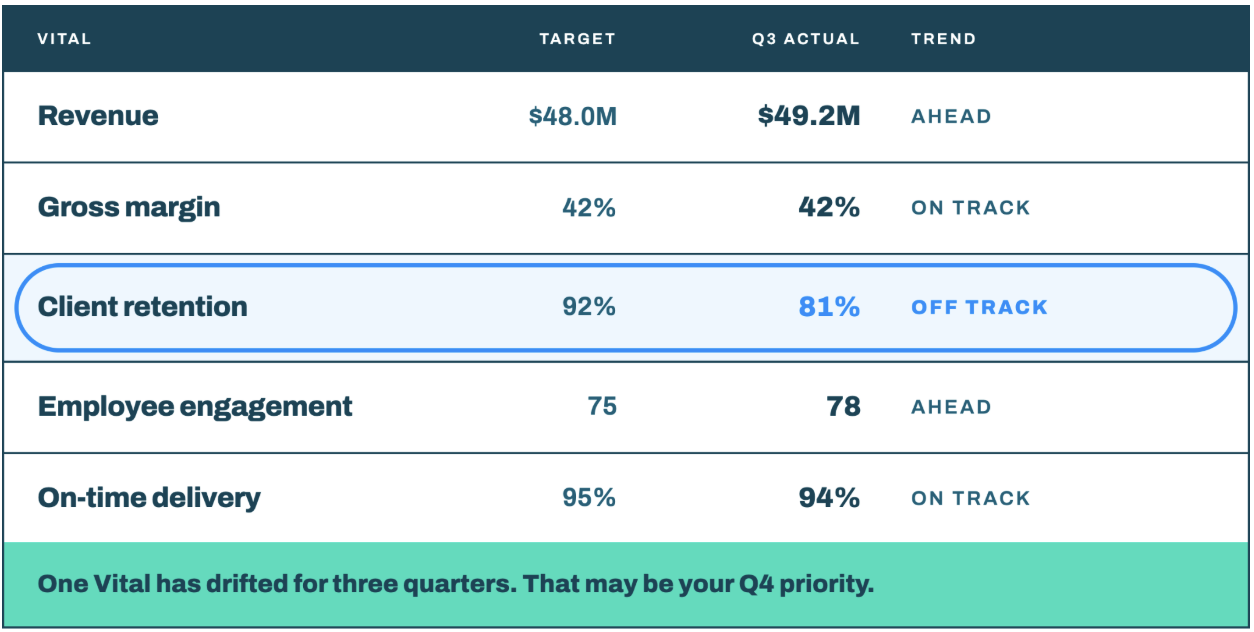
Your goals aren't the only place to look. Hopefully, your leadership team has a small set of Vitals, the essential metrics that tell you whether your organization is healthy and succeeding. Revenue, margin, retention, customer or client outcomes, employee engagement, quality, or whatever measures matter most for your organization.
Before setting your Q4 priorities, put those numbers in front of the team.
Where are you ahead? Where are you behind? What has been trending in the wrong direction? Is there a Vital that you expected to be in a very different place by this point in the year?
Your Vitals may reveal something that your existing list of priorities doesn't. Perhaps a metric that has slowly drifted for two quarters now deserves focused attention. Or maybe a strong result gives you confidence that you can take your foot off the gas in one area and redirect energy somewhere else.
Trap 1: Don't Pretend You Have a Full Quarter
There is another mistake even disciplined teams can make as they plan for Q4: significantly overestimating their available capacity. Q4 may technically contain roughly 13 weeks, but most teams don't have 13 normal working weeks.
Thanksgiving and the December holidays alone remove meaningful working time. Add vacations, personal travel, conferences, internal events, year-end board meetings, budgeting, and planning for next year, and suddenly the quarter gets very compressed.
Yet it's easy to enter Q4 with the same number of priorities you carried into Q2 or Q3. Don't build your Q4 priorities around the number of weeks on the calendar. Build them around the capacity your team actually has.This might be the quarter to narrow rather than expand. Finishing three important things may create far more value than making modest progress on seven.
Trap 2: Don't Move Into Next Year Too Soon
Q4 creates one more temptation, particularly for forward-thinking leadership teams. Your attention is already drifting toward next year.
You're imagining next year's goals. New ideas are emerging and you may already be talking about your vision for next year with your team. You probably already have a running list of things you want to tackle in January.
Its certainly good to capture those ideas, but don't allow your excitement about what's next to pull your team's attention away from what still needs to be finished.
You can start imagining next year without prematurely leaving this one. Your organization still needs you fully engaged in this year's goals, Vitals, and priorities. One of the best ways to protect your team from drifting too far into next year, is to set aside 2 days to do your annual planning for next year. Knowing you have those dates on the calendar will give you the freedom to finish the current year well.
A Final Thought
A strong quarterly rhythm is valuable because every 90 days it forces us to make choices again. And the choices we make entering Q4 may be some of the most important of the year.
Look back at what you said mattered. Look honestly at what your Vitals are telling you. Account for the capacity you actually have. Capture your ideas for next year without allowing them to steal your attention from this one.
Then decide together what deserves your best collective energy for the final stretch. There is still a quarter left. Finish it well.
-Shaun & Joe