
The Four Forms of Hope
We recently wrote about the science of hope and one of the most important lessons it teaches us: hope is not simply optimism. Hope is the belief that a better future is possible and that there is a believable pathway to help create it.
That distinction matters because hope doesn't just shape how people feel—it shapes how they perform. Research has found that hopeful employees are more creative, achieve higher levels of performance, experience greater well-being, and are less likely to burn out or leave their organization. In other words, hope isn't simply a "nice to have." It's a meaningful driver of organizational performance.
For leaders, the challenge is that people are rarely moved by aspiration alone. A compelling future can inspire people for a moment, but if they cannot see a credible path forward, that inspiration eventually turns into skepticism. At the same time, a credible plan without a meaningful future can keep people stable, but it rarely mobilizes them.
That's why we were excited to read a recent Harvard Business Review article introducing what the authors call the Four Forms of Hope. Their framework reminds us that hope is created by balancing aspiration with credibility.
The four quadrants are simple:
Mobilizing Hope (high aspiration, high credibility)
Inflated Hope (high aspiration, low credibility)
Stabilizing Hope (low aspiration, high credibility)
Empty Hope (low aspiration, low credibility)
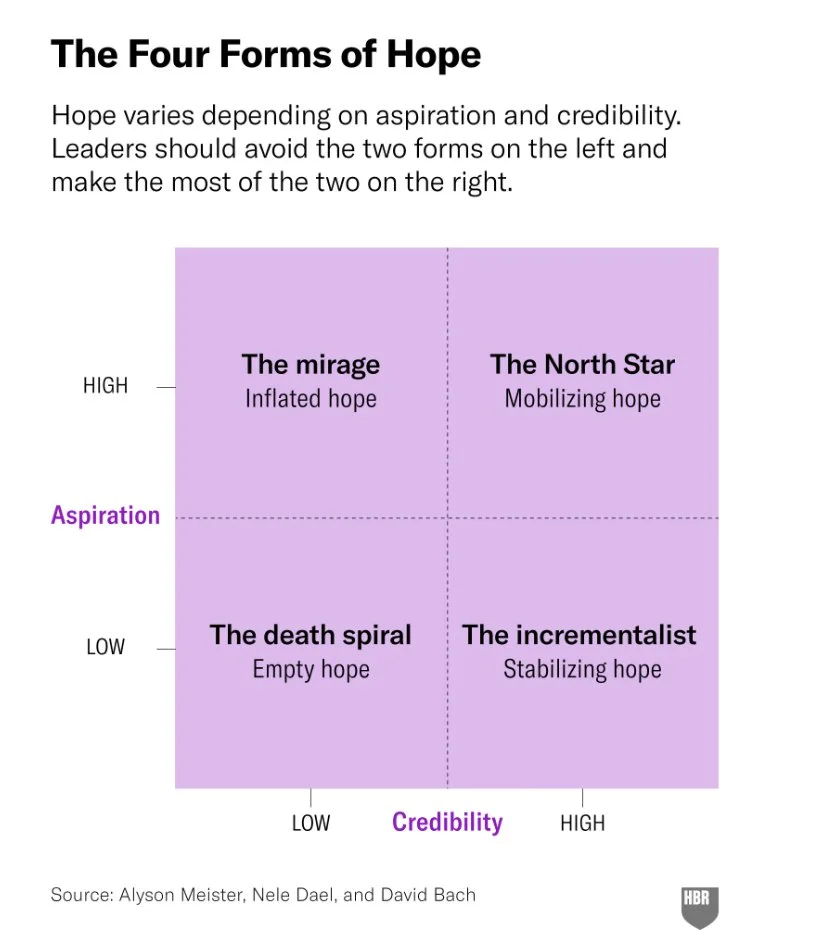
The North Star is clearly Mobilizing Hope, a compelling future paired with believable pathways for getting there.
As we read the article, we found ourselves asking a practical question:
How do leadership teams intentionally move toward that quadrant?
Here are three ways we've seen organizations do exactly that.
Empty Hope Needs Clarity and Focus
Empty hope occurs when people don't believe tomorrow will be much different than today. The future isn't inspiring, and the present doesn't make much sense either. Leaders often respond by communicating more, but communication alone rarely solves the problem.
People regain hope when they understand both where the organization is headed and how they can help move it there.
One of the greatest gifts leaders can give their teams is focus. When everything is a priority, people struggle to see how their work contributes to meaningful progress. But when organizations establish a small number of annual priorities and then quarterly priorities something begins to change. People stop feeling like they're simply staying busy and begin feeling like they're contributing towards something significant.
That clarity creates momentum because everyone can answer two important questions: What matters most right now? and How can I help us get there? Hope grows when people can see a future worth building and understand the role they play in helping create it.
Inflated Hope Needs strong Collaborative Systems
Most leaders don't intentionally create inflated hope. It usually comes from a genuine desire to inspire people.
The challenge is that vision without a believable path eventually erodes trust. People don't simply need to know where the organization is going. They need confidence that the organization has the discipline to get there.
One of the most powerful ways leaders build that confidence is through consistent operating rhythms.
When teams establish quarterly priorities, regularly review progress, solve obstacles together, and adjust course as they learn, something important happens. Vision stops feeling like an inspiring speech and starts becoming a visible process. Team members can see that the organization isn't simply talking about the future—it's steadily building it.
Strong rhythms also create accountability. They ensure priorities don't quietly disappear beneath the urgency of day-to-day work. Instead, the organization returns to them week after week and quarter after quarter, reinforcing that what was declared important actually remains important.
People don't trust a vision just because its inspiring. They trust it because they consistently see progress toward it.
Stabilized Hope needs to push out of its comfort zone.
There are seasons when stabilizing hope is exactly what people need.
During periods of uncertainty, leaders earn credibility by acknowledging reality, preserving trust, and helping people take the next step rather than pretending to have all the answers. The HBR authors make a compelling case that this approach is often the right response during disruption.
But stabilizing hope isn't meant to become a permanent leadership strategy.
Eventually, teams need to believe they are building something bigger than simply surviving.
One of the most effective ways we've found to create that shift is through intentional learning rhythms. Quarterly Syncs, retrospectives, and regular reflection help teams see progress, learn from experimentation, and adjust together. Every retrospective reinforces the same message: we're learning, we're improving, and we're moving forward.
Over time, those small moments of progress become the foundation for Mobilizing Hope.
Final Thought
Hope becomes a powerful leadership force when aspiration and credibility grow together.
In our experience, that's exactly what healthy leadership systems are designed to do. They create clarity around purpose. They establish meaningful priorities. They make progress visible. And they create rhythms that help teams continually learn and improve together.
When those conditions are in place, hope stops being wishful thinking.
It becomes one of the most powerful drivers of engagement, ownership, and organizational performance.
-Shaun & Joe