
Psychological safety has become a familiar topic in leadership circles, and that's a good thing. But we wonder if some teams have lost the plot.
More leaders recognize the importance of creating environments where people feel accepted, respected, and comfortable speaking up. We've seen firsthand how much of a difference this can make in the health of an Executive Team.
But as we listen to leaders talk about psychological safety, we wonder if our understanding of what it's meant to accomplish has become too limited.
Too often, it gets treated as a soft skill, something designed primarily to help people feel more comfortable at work. That's an important starting point. But when it comes to building a high-performing team, comfort isn't the ultimate goal.
The real opportunity is to create a team where people feel secure enough to take meaningful ownership, exercise independent judgment, and challenge one another in pursuit of better outcomes.
Psychological safety isn't simply about helping people feel comfortable. It's about creating the conditions for a team to accomplish more together than they ever could otherwise.
The Four Stages of Psychological Safety
In his book The 4 Stages of Psychological Safety, Timothy R. Clark describes four progressive stages, each building on the foundation established by the previous one.
1. Inclusion Safety: I belong. People feel accepted, respected, and valued as members of the team. Leaders strengthen this safety by building relationships, welcoming different perspectives, and ensuring everyone has a voice.
2. Learner Safety: I can learn and grow. People feel safe asking questions, experimenting, and making mistakes. Leaders strengthen this safety by investing in people's growth, demonstrating humility, and giving others room to get things wrong.
3. Contributor Safety: I can make a meaningful contribution. People feel trusted to use their skills, exercise judgment, and take ownership. Leaders strengthen this safety by recognizing contributions, delegating meaningful responsibility, and giving people autonomy in how they accomplish their work.
4. Challenger Safety: I can challenge the status quo. People feel safe questioning assumptions, disagreeing with authority, and advocating for better ways of doing things. Leaders strengthen this safety by inviting dissent, responding without defensiveness, and supporting those willing to challenge established thinking.
What’s compelling about this framework is the relationship between the stages.
The first two establish an essential foundation. People need to know they belong and can learn without constantly worrying about how others will judge them.
But stages three and four are where we begin to see some of the most meaningful benefits for team performance. If you've ever wondered about the payoff of investing in psych safety, 3 and 4 is the answer to that wondering.
We invest in belonging and learning so that people can contribute and challenge at a higher level. When those behaviors become normal, it's a strong signal that psychological safety is becoming part of how the team performs.
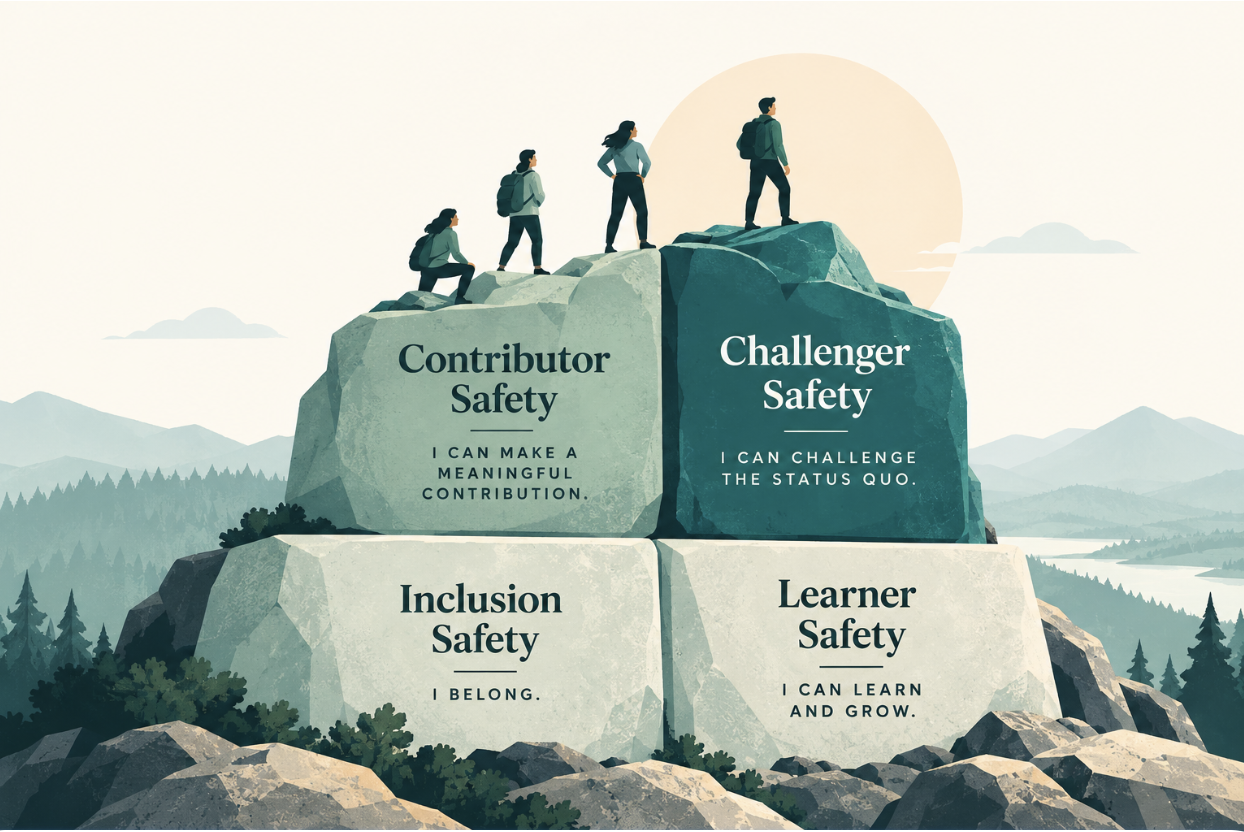
Where Psychological Safety Begins to Drive Performance
Think about the difference between an Executive Team where people merely feel comfortable with one another and one where people both trust each other and are accomplishing more together.
On the first team, people might enjoy strong relationships, openly acknowledge mistakes, and feel supported by their colleagues. Those are meaningful signs of psychological safety.
But that same team might still struggle to share ownership of organizational priorities and to be accountable to achieving them. Members may hesitate to make decisions without the CEO's approval or avoid challenging one another when they disagree. This is where stages 3 and 4 - Contributor Safety and Challenger Safety become so important.
Contributor Safety: From Participation to Ownership
It's one thing for people to feel comfortable sharing their ideas. It's another for them to feel trusted to act on those ideas, exercise judgment, and take responsibility for outcomes.
When Contributor Safety is strong, leaders don't have to control every decision. They can delegate meaningful responsibility, give others autonomy in how they accomplish their work, and recognize the contributions their teammates make.
The result is a team where leadership is genuinely shared rather than concentrated in one person. Imagine an Executive Team where each member owns an important strategic priority and feels empowered to make decisions and move the work forward without seeking approval at every turn.
That kind of autonomy requires a high degree of trust, built on the foundation of belonging and learning established in the first two stages.
And the payoff is significant. Rather than relying on one leader to drive the organization's most important priorities, you have an entire team capable of moving meaningful strategic work forward together.
Challenger Safety: From Going Along to Intently Exploring Differences
This is where psychological safety becomes especially powerful. Consider an Executive Team discussing a major strategic decision. The CEO shares a strong opinion about the direction the organization should take.
Does everyone quickly fall in line? Or do team members feel comfortable questioning the assumptions behind that recommendation, offering competing perspectives, and pushing the conversation toward a better answer?
Challenger Safety doesn't mean people disagree simply for the sake of disagreeing. It means they care enough about the team's success that they will challenge ideas even when doing so involves interpersonal risk.
And it requires something important from leaders: the ability to welcome a challenge without interpreting it as a threat to their authority.

A team with strong Challenger Safety isn't more comfortable but it’s more capable of navigating uncomfortable conversations productively. That's one of the clearest signs that psychological safety is contributing to high performance.
A Final Thought
Psychological safety is essential to a healthy team. But we shouldn't confuse the foundation with the destination.
You should want everyone on your team to feel a true sense of belonging. You should intentionally invest in them feeling safe to learn and grow……and we should expect those investments to produce something more.
A team where people take initiative without waiting for permission. Where teammates challenge one another because they're committed to getting to the best answer. Where leaders welcome dissent rather than feel threatened by it.
Those are some of the characteristics that distinguish truly high-performing teams.
So here's a question worth asking your Executive Team: Have we focused primarily on helping people feel safe, or are we seeing the kind of contribution and healthy challenge that strong psychological safety is meant to make possible?
-Shaun & Joe