
Why Two People Experience the Same Conflict Differently
Many difficult conversations don't go poorly because someone lacked communication skills. They often go poorly because we're responding to the story we've constructed rather than the situation itself.
Long before a word is spoken, each person has already interpreted what's happening through a lifetime of experiences, assumptions, and beliefs. Two people can experience the exact same interaction and walk away with completely different conclusions, not because either is dishonest, but because they're looking through different lenses.
Management researcher Chris Argyris spent decades studying this phenomenon. Through what he called the Ladder of Inference, he demonstrated how quickly our minds move from observing facts to assigning meaning, making assumptions, and drawing conclusions, often without realizing we've filled in the gaps ourselves
Think about the last time someone challenged one of your ideas in a meeting. One leader might hear curiosity while another hears criticism. One assumes the other person is trying to improve the idea while another assumes they're trying to undermine it. The event is exactly the same, but the interpretation is completely different.

Your Conflict Lens Was Formed Long Before the Conversation
One of the biggest breakthroughs leaders experience is realizing that their relationship with conflict didn't begin in their current role or with the context of one difficult relationship. It began years earlier.
Every meaningful experience we've had with conflict leaves an impression. Some of us learned that conflict damages relationships, so we avoid it. Others learned that the loudest voice wins, so we push harder. Some learned that keeping the peace is the highest priority, while others came to believe that directness is the greatest form of respect.
Those experiences don't stay in the past. They shape the beliefs we hold about conflict today, and those beliefs influence the assumptions we make, the stories we tell ourselves, and ultimately how we respond when tension arises.
Most of us don't consciously choose those responses because we assume we're seeing the situation as it really is. In reality, we're seeing it through a lens that has been forming for years.
That's why two thoughtful, well-intentioned leaders can experience the same conversation so differently. One walks away feeling attacked. The other leaves believing they were simply asking good questions. One assumes the relationship has been damaged. The other wonders why the conversation felt so difficult in the first place.
Greater Self-Awareness Leads to Healthier Conflict
One of the reasons we spend time helping leaders reflect on their conflict lens is because self-awareness changes the way we enter difficult conversations.
If we go back to Chris Argyris's research, it helps explain why. His work showed that our minds naturally move from observing facts to assigning meaning, making assumptions, and drawing conclusions, often without realizing we've made that journey. Before long, we're no longer responding to what happened. We're responding to what we believe happened.
Understanding our conflict lens helps us interrupt that process.Once we recognize that our interpretation is just one possible interpretation, we become more curious. We ask better questions. We seek to understand before drawing conclusions. Rather than assuming our first story is reality, we learn to test it.
Put it to Practice - A Simple 5-Minute Pause
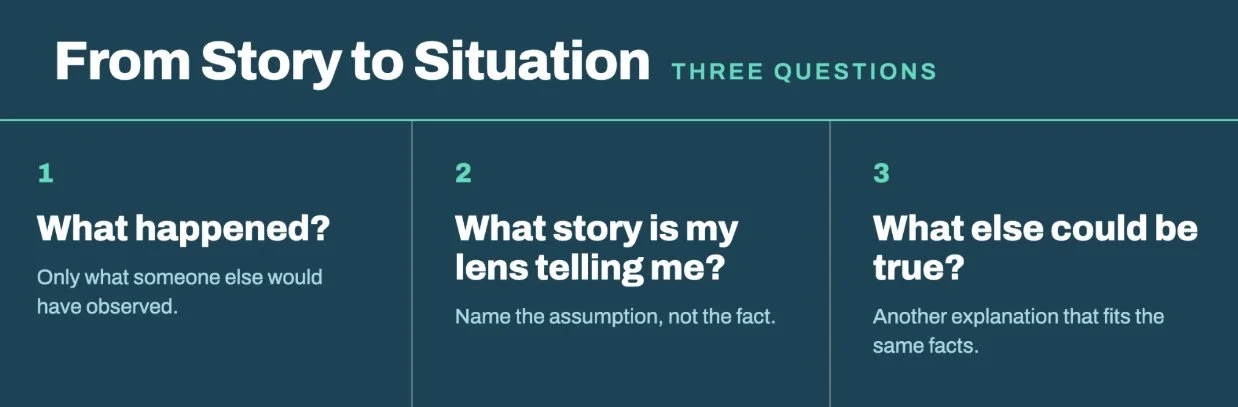
The next time you find yourself becoming defensive, frustrated, or making quick assumptions about someone else's intent, pause and ask yourself three questions.
1. What happened?
Separate what happened from what you think it means. What would someone else have observed?
"They questioned my proposal."
"They interrupted me."
"They haven't responded to my email."
2. What story is my lens telling me?
Name the assumptions you're making. The story may be true, but at this point it's still an interpretation, not a fact.
"They don't trust me."
"They're trying to make me look bad."
"They don't value my opinion."
Our minds naturally fill in the gaps, often without us realizing it. The story may be true, but at this point it's still a story, not a fact.
3. What else could be true?
Challenge what your story might be telling you. Is there another explanation that fits the facts just as well?
Maybe they're asking hard questions because they care about getting the decision right.
Maybe they're under pressure.
Maybe they misunderstood your intent.
Maybe they simply see the situation differently than you do.
This simple pause won't eliminate conflict, but it often prevents us from reacting to the story we've constructed rather than the situation itself.
A Final Thought
This week, we'd encourage you to spend a few minutes reflecting on your own conflict lens. What experiences most shaped the way you think about conflict?
What beliefs did those experiences leave behind? How might those beliefs still be influencing the conversations you're having today?
-Shaun & Joe