
You Have More Than One Leadership Team
When leaders hear the phrase leadership team, they almost always think about the executive team. As you have heard us say before, that group carries enormous responsibility. It shapes strategy, culture, and the overall direction of the organization.
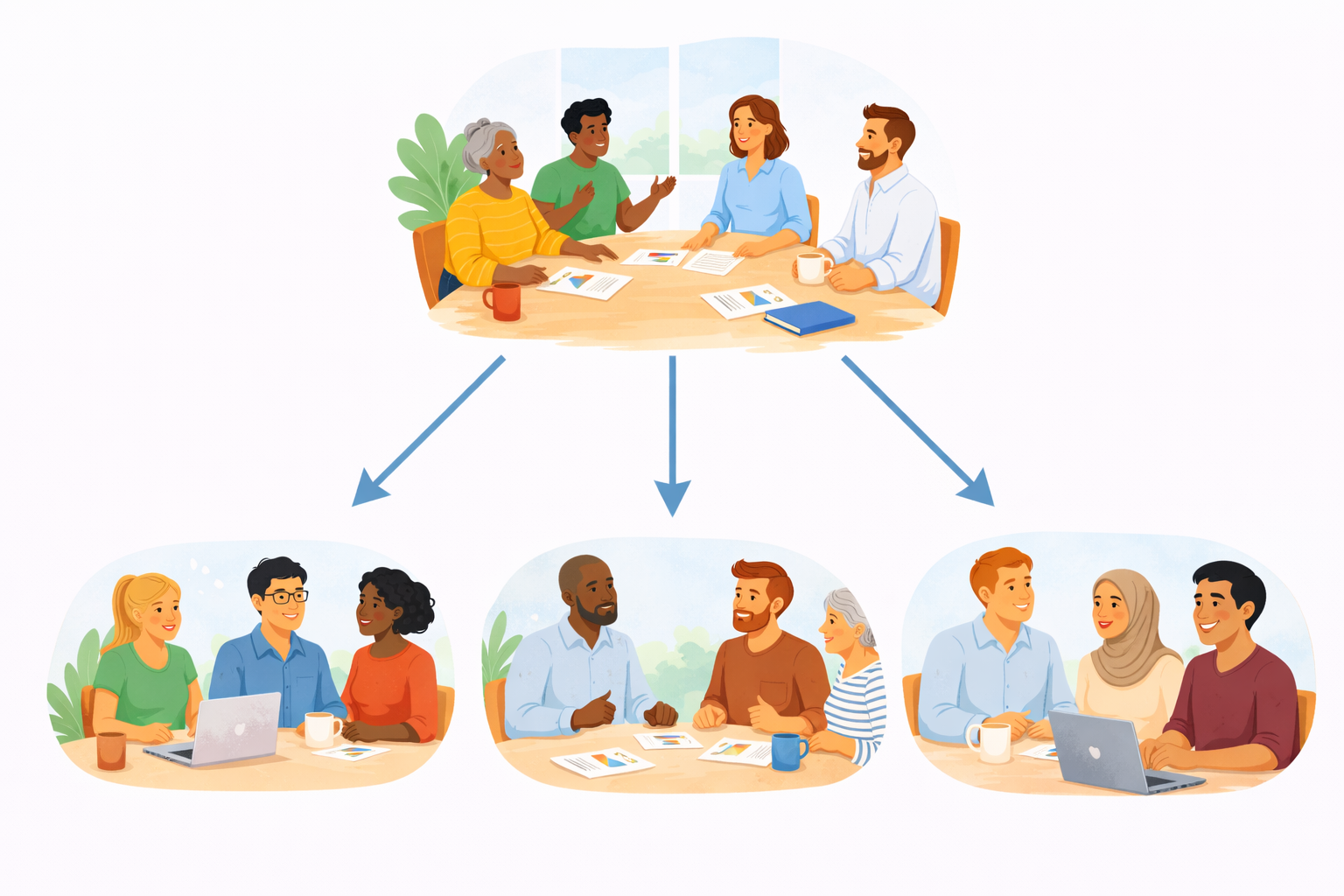
But in most organizations, the executive team is not the only group responsible for leading. As organizations grow, departments, regions, and major functions often operate at a scale that requires their own leadership team - small groups of leaders collectively responsible for fostering engagement, nurturing culture and creating the conditions for everyone on the team to thrive.
You might see this in a program leadership team, a product development leadership team, a regional leadership team, or an operations leadership team.
Seen this way, most organizations do not actually have a single leadership team. They have several.
And yet, many of these groups are never truly recognized or developed as leadership teams. Instead, leadership often defaults to a single department or function leader who is expected to carry the responsibility on their own.
As a result, these teams are expected to operate effectively without ever intentionally defining how they will work together.
Organizations Execute Through Teams of Leaders
One of the most important lessons we have learned in working with organizations is that execution rarely happens through individual leaders operating in isolation.
Organizations execute through teams of leaders working together. As Amy Edmondson suggests in Teaming, performance increasingly depends on how well people work together, not just how well they perform individually.
Most executives experience the power of this dynamic within the executive team itself. When leaders gather regularly to interpret priorities, solve problems, and hold one another accountable, the organization benefits from stronger thinking, faster coordination, and better decisions.
The challenge is that this dynamic often exists only at the executive level, if at all.
Below that level, leaders frequently operate through two primary structures. They meet one-on-one with their manager to review performance, discuss challenges, and receive coaching. They also participate in larger “managers meetings,” where updates are shared and organizational announcements are made. These rhythms can serve important purposes, but they aren’t designed for the kind of shared leadership the work actually requires.
As a result, many capable leaders spend most of their time operating individually rather than collaborating with peers who are responsible for adjacent parts of the organization’s work.
What is often missing is the opportunity for leaders responsible for a shared domain to operate as a team of leaders guiding the work together.
We describe this shift as moving from leadership to Teamship.
Teamship emerges when leaders stop operating primarily as individual department heads and begin functioning as a leadership team that unlocks the collective potential of the work they are responsible for guiding.
The Hidden Potential Inside Most Organizations
Most organizations already have capable leaders responsible for important parts of the work. Program leaders guide service delivery. Product leaders oversee development and innovation. Regional leaders coordinate work across locations. Operations leaders manage execution and infrastructure.
The challenge in most cases is not a shortage of capable leaders. The challenge is more often the systems and norms (or lack of) those leaders work within.
In many organizations, leaders below the executive team operate primarily as individuals leading their own departments. They coordinate upward with their manager but far less frequently across with peers responsible for related work. This leaves a tremendous amount of leadership capacity untapped.
When leaders responsible for a shared part of the organization begin operating as a leadership team, something meaningful begins to change. Leaders start interpreting priorities together rather than independently. They coordinate work earlier in the process. Challenges surface sooner, and the team develops a shared understanding of what success looks like.
In other words, the progress happens through teams of leaders practicing Teamship rather than isolated individuals managing departments. That shift unlocks enormous potential across the organization.
Putting Teamship into Practice
Of course, simply bringing leaders together does not automatically produce these outcomes. Leadership teams become powerful when they develop a clear and intentional way of working together. This is what we often refer to as a team operating system.
A leadership team’s operating system consists of the shared agreements and systems that shape how the team collaborates. It provides clarity around how the team works together day to day, including:
How priorities are set and adjusted over time
How decisions are made and who is involved
How disagreement and conflict are navigated
How feedback is exchanged in ways that strengthen trust and performance
It also shapes the rhythms and structures that support the team’s work, such as:
How meetings are designed and facilitated
How communication flows between team members
How progress is tracked and accountability is maintained
When these elements remain undefined, teams tend to fall back on individual habits and preferences. Meetings become less productive than they should be, priorities drift out of alignment, and collaboration becomes inconsistent.
When these systems are designed intentionally, something very different begins to happen. The team gains clarity, consistency, and the infrastructure needed to practice Teamship over time. In practice, this often takes shape through a few core elements:
A team charter that clarifies purpose, roles, and shared responsibility
A goal-setting framework that aligns priorities and tracks progress
Clear agreements for navigating conflict and making decisions
Systems for giving and receiving feedback regularly
Intentional meeting rhythms and communication norms
These systems rarely draw much attention when they are working well, yet they quietly shape how effectively a team operates week after week.
The Power of (Many) Leadership Teams
When leadership teams operate intentionally, their influence extends far beyond the team itself. What begins as a structural shift often becomes one of the most powerful drivers of organizational health and performance.
At the heart of this change is the development of Teamship where leaders operate not simply as managers of separate departments, but as a team responsible for guiding a shared part of the organization.
When that shift takes place, several important benefits begin to emerge.
Stronger Execution of Strategy: When leaders operate as a team, strategic priorities are interpreted and translated into action together rather than independently. Leaders break down priorities into shared initiatives, monitor progress collectively, and address barriers earlier. Instead of multiple departments moving in slightly different directions, the team develops a shared understanding of what success looks like and how to achieve it.
Deeper Alignment Across Leaders: Many organizations attempt to create alignment primarily through communication—presentations, memos, or leadership updates. While communication is necessary, alignment rarely emerges from communication alone. Alignment develops when leaders have space to interpret strategy together, ask questions, and discuss the implications for their work.
Better Coordination Across Teams: Much of the most important work in organizations sits between teams rather than within them. Leadership teams create a place where leaders responsible for related work can identify dependencies, coordinate timelines and resources, and resolve tradeoffs before they slow progress.
Accelerated Leadership Development: Leadership teams also become powerful environments for developing leaders. As leaders work together regularly to solve problems and navigate complex decisions, they learn from observing how their peers approach challenges. They practice giving and receiving feedback and develop the ability to disagree productively while remaining aligned around shared outcomes.
Over time, this strengthens not only individual leadership capability but also the ability to lead alongside others, which becomes increasingly important as organizations grow.
This experience also prepares leaders for broader responsibility. Leaders who develop their leadership within these teams often become strong candidates to step into new roles across the organization—whether that means leading a different department, guiding a regional effort, or eventually joining the executive team.
A Stronger Culture of Shared Ownership: When leaders practice Teamship, their sense of responsibility expands beyond their own department. They begin to feel collective ownership for the outcomes of the entire domain they guide together, which strengthens relationships, accountability, and trust across the organization.
Few structural shifts influence execution, leadership development, and culture at the same time. Leadership teams do exactly that by creating environments where Teamship becomes the norm.

Alignment Across Leadership Teams
As organizations develop multiple leadership teams, another opportunity emerges.
It becomes especially powerful when those teams operate from a shared philosophy about how teams work.
When leadership teams across the organization adopt similar approaches to goal setting, feedback, decision-making, and collaboration, alignment becomes much easier to sustain. Leaders begin to share a common language and a clearer understanding of what effective teamwork looks like.
At the same time, each leadership team should have the opportunity to shape its operating system in ways that reflect the nature of its work.
A program leadership team may structure its meetings differently than a product development team. A regional leadership team may establish different communication rhythms than an operations group.
What matters is that each team is intentional about how it works.
The goal is not uniformity. The goal is alignment combined with ownership, allowing Teamship to take root in ways that reflect the real work each leadership team is responsible for guiding.
A Final Thought
Most organizations experience the power of leadership teams only at the executive level.
But the same dynamic that strengthens the executive team can strengthen the entire organization.
When leadership teams exist throughout the organization—and when those teams develop clear operating systems for how they work together—execution becomes more coordinated, leaders develop more quickly, and culture becomes more connected.
In the end, organizations do not execute through individual leaders alone.
They execute through teams of leaders practicing Teamship together.
-Shaun & Joe