
The Leadership Move That Builds an Ownership Mindset
One of the more difficult shifts leaders have to make is learning to resist their instinct to give too much advice.
For many of us, our careers advanced precisely because we were good at solving problems. We developed expertise, we built credibility through good judgment, and people trusted us because we could see solutions that others might miss.
So when someone on our team brings us a challenge, the instinct feels almost automatic. We listen briefly, recognize the issue, and begin offering suggestions. Often those suggestions are thoughtful and well intentioned. But something subtle happens when leaders become the primary source of answers.
The people around us stop developing their own ability to think through problems. Ownership slowly shifts upward. Instead of building a team of capable problem solvers, we unintentionally become the person everyone relies on to move the work forward.
Over time, this dynamic becomes exhausting for the leader and limiting for the team.
This is where coaching becomes an essential leadership skill.
The Coaching Triangle
When we introduce coaching in our Leading with Intention program, we often start with a simple model we call the Coaching Triangle.
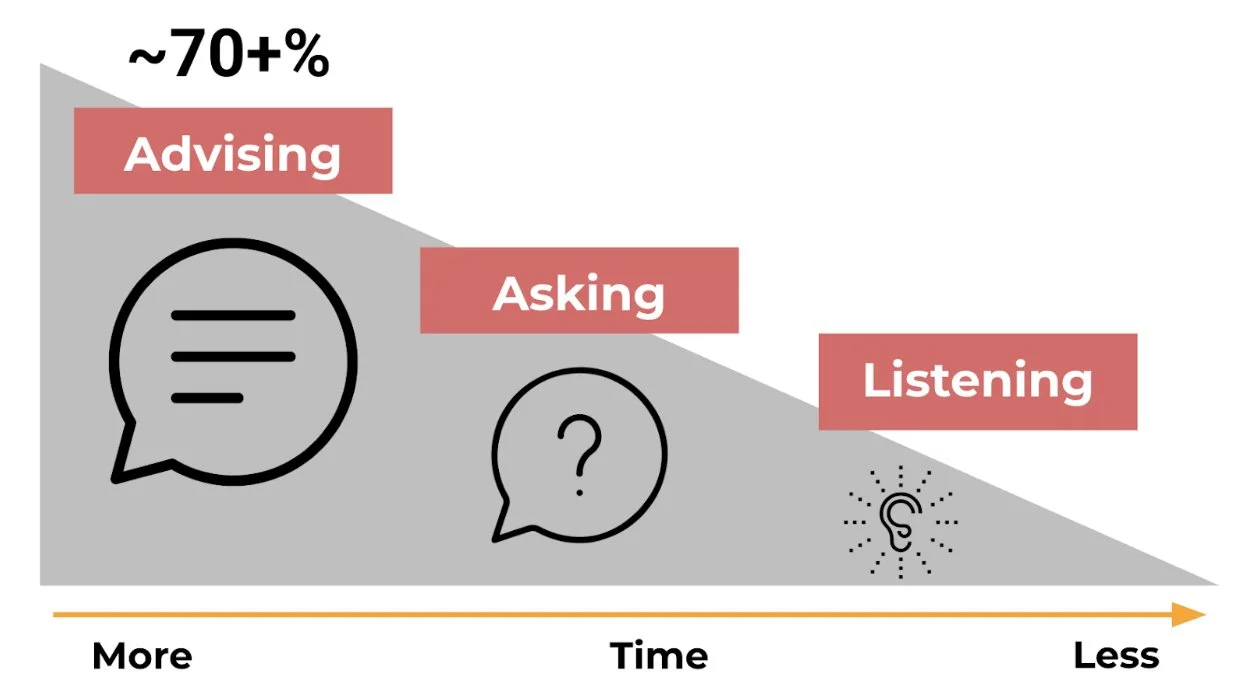
Most leaders instinctively spend the majority of their time in the advising corner of the triangle. In fact, in many conversations more than 70% of the leader’s contribution comes in the form of advice or solutions.
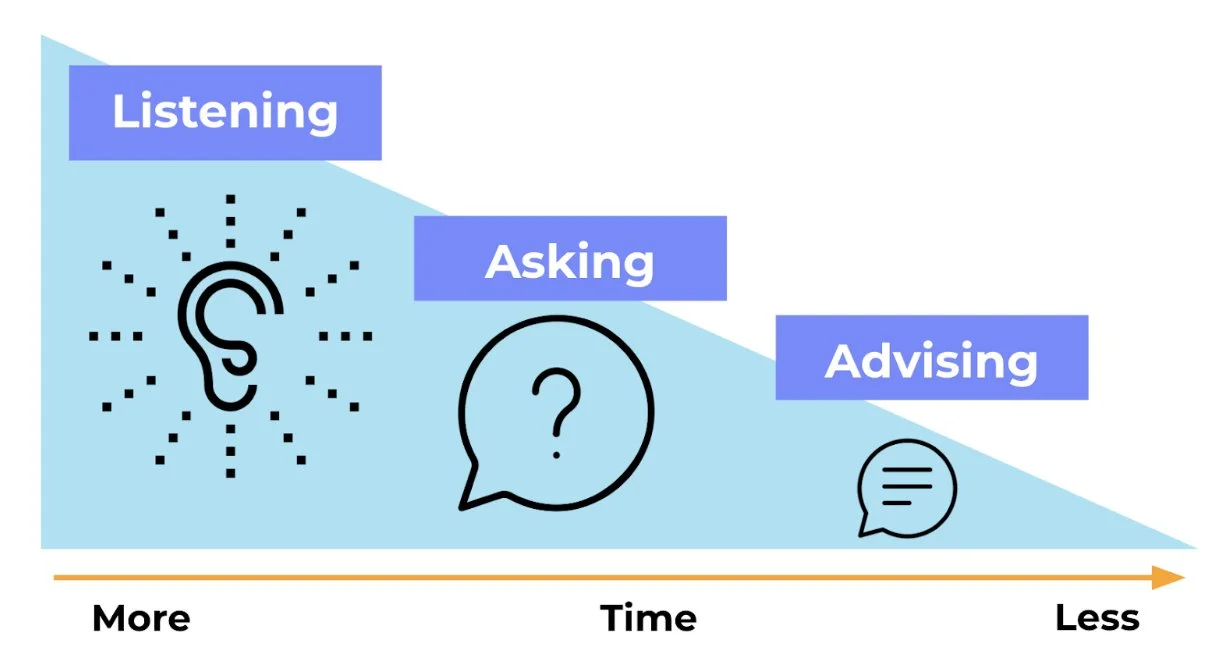
The irony is that the conversations that lead to the most growth look very different. They spend far more time listening and asking questions. Advice still has a role to play, but it becomes a smaller and more intentional part of the conversation.
The Shift Coaching Requires
Effective coaching begins by shifting where we spend our time. Rather than jumping quickly into solutions, coaching conversations often begin with listening carefully enough to fully understand what someone is experiencing.
Listening communicates something important before a single piece of advice is given. It tells the other person that their perspective matters and that their thinking is worth exploring. In a previous newsletter, we talked about the power of validation—the simple act of helping someone feel seen and understood. Listening is one of the primary ways leaders communicate that validation.
When people feel understood, they become more open to thinking, reflecting, and learning.
From there, thoughtful questions begin to open the conversation. Questions encourage reflection and help someone clarify what is actually happening, what obstacles they may be facing, and what options might be available.
Often the most meaningful insight in a coaching conversation comes not from what the leader says, but from what the other person discovers while thinking out loud.
When leaders slow down enough to listen and ask thoughtful questions, people begin to develop their own capacity to navigate challenges. Over time, this builds confidence, ownership, and stronger problem-solving across the team.
What Gets in the Way
If coaching is so powerful, why do leaders struggle to do it consistently? In our experience, there are a few common barriers.
First, coaching requires skill. Listening deeply and asking thoughtful questions does not always come naturally. Many leaders have spent years developing their expertise in solving problems, but far less time practicing the conversational skills that help others think more clearly about their challenges.
Second, coaching does not always produce immediate results. When someone arrives at their own answer, it can take more time than simply giving advice. In fast-moving environments, leaders sometimes feel pressure to move quickly, which can lead them back to familiar patterns of solving the problem themselves.
Third, there is often a misconception about what coaching really means. Some leaders assume that coaching requires them to avoid giving advice altogether or to step back from holding people accountable.
But effective coaching does neither.
A strong coaching partner helps someone think through a situation, encourages them to identify their own path forward, and then works with them to lock in clear next steps. Once those commitments are made, accountability becomes an important part of the process.
In other words, coaching is not passive. It is an intentional way of developing people while still ensuring that progress happens.
A Coaching Example: Steve Kerr
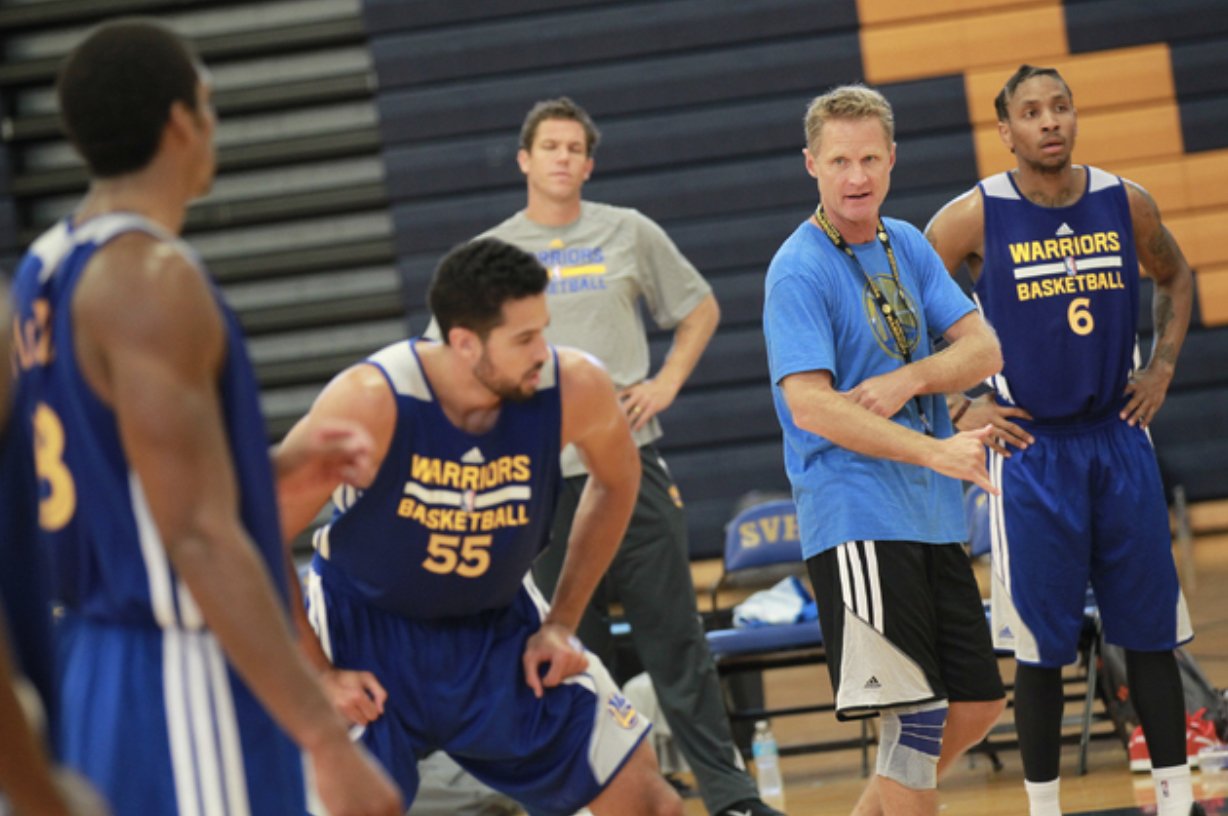
One of the coaches who models this approach particularly well is Steve Kerr, head coach of the Golden State Warriors.
If you watch Kerr during practices or timeouts, you’ll notice something interesting about his style. He rarely treats coaching as a series of instructions. Instead, he spends a surprising amount of time asking players what they are seeing on the court.
Rather than immediately telling a player what went wrong, Kerr might ask a question like:
What did you see on that possession?
Where did the help defender come from?
What option did you have there?
The purpose of the question is not simply to check understanding. It is to help the player develop their own ability to read the game.
Basketball is a sport where decisions happen in fractions of a second. No coach can control every moment once the game begins. Kerr understands that if players are going to succeed, they must be able to think clearly under pressure and adapt in real time.
That kind of awareness cannot be developed through constant instruction. It develops when players are encouraged to reflect, analyze, and discover the answers themselves. In other words, Kerr coaches the way great leaders develop people. He creates conversations that help others see more clearly rather than simply telling them what to do.
Going Deeper
If this idea resonates with you, coaching conversations are one of the core leadership skills we practice in our Leading with Intention program.
The course helps leaders strengthen everyday conversations that shape growth, engagement, and ownership across their teams. Participants learn practical tools for:
• Listening in ways that deepen understanding
• Asking questions that unlock insight and reflection
• Offering advice in ways that preserve ownership and confidence
Our next cohort begins March 24th.
If you are interested in joining the next group of leaders developing these skills together, we would love to have you with us.
-Shaun & Joe