
We Agreed in the Room, but Are We Really Aligned?
The meeting ends on time. Everyone nodded along to the decision. No one raised an objection. Walking out of the room, it felt like alignment.
Two weeks later, three different versions of "what we decided" are circulating through the organization. One leader told their team the priority shifted. Another told their team it didn't. A third hasn't mentioned it at all. Nobody lied and nobody meant to cause confusion. And yet, somehow, the team wasn't aligned at all.
This is one of the most common blind spots we see on leadership teams. We treat the meeting as the finish line. If no one pushed back, if heads nodded, if the meeting wrapped without tension, we read that as consensus. But agreement in the room isn't always the same thing as alignment. At times, it's just the feeling of alignment, and that feeling holds up fine until it's actually tested.
The Abilene Paradox: When Everyone Agrees to Something No One Wants
In 1974, management professor Jerry Harvey told a story that has become a classic in organizational psychology. On a hot afternoon in Texas, a family sat on a porch, content to do nothing. Then someone suggested driving fifty miles to Abilene for dinner. One by one, each family member agreed, not because they wanted to go, but because they assumed everyone else did. They made the long, uncomfortable drive, ate a forgettable meal, and returned home exhausted.
On the porch afterward, someone finally admitted they hadn't wanted to go in the first place. It turned out no one had. The whole trip happened because each person mistook silence for enthusiasm and went along with a decision that not one of them actually supported.
Harvey called this the Abilene Paradox, and it describes something leadership teams do constantly. A room full of smart, well-intentioned people nods along to a direction, each person assuming the others are on board, when in reality several of them have quiet doubts they never voiced. The room agrees, but nobody actually agrees.
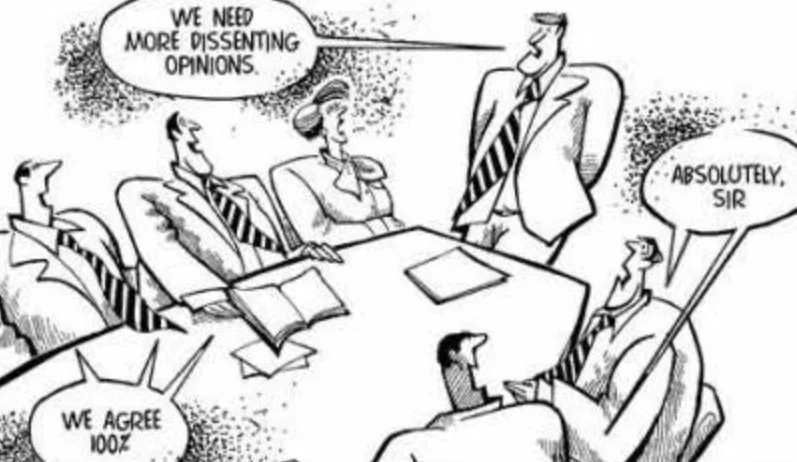
Agreement in the Room Is Not the Same as Alignment
Here is the deeper problem. Even when a team genuinely agrees on something, that agreement is fragile until it survives being retold. Alignment isn't just tested in the meeting. It's also tested afterward, when each leader has to explain the decision to their own team.
A decision only holds as well as its most diluted version. If five leaders leave a meeting with five slightly different understandings of what was decided and why, the organization doesn't experience one decision. It experiences five, and it usually takes weeks to notice the difference.
We have seen this play out over and over with leadership teams we work with. A decision gets made. Everyone seems on board. Then a few weeks later, a leader mentions offhand that they weren't sure that was really the final call, or that they told their team something slightly different because that's how they understood it. Nobody was being dishonest. They just never tested whether the room's agreement was real.
What High-Performing Teams Do Differently
The good news is that this is a solvable problem, and it doesn't require a personality overhaul. It requires a system. Here are three practices we see strong leadership teams use to catch misalignment before it leaves the room.
Invite Disagreement: Invite the dissent you'd otherwise never hear. Silence is not the same as agreement, and the people most likely to stay quiet are often the most senior or the most agreeable. Ask directly: "Is there anyone who sees this differently?" Give it a beat. Real dissent rarely arrives in the first three seconds of silence.
In Your Own Words: Round the room before you close a decision. Before moving on, ask each leader to say out loud, in their own words, what was decided and what they'll tell their team. If five people describe five different decisions, you just found the gap while it's still easy to fix.
Next Week Check: Check the translation, not just the decision. A short follow-up, even a quick async message, asking what each leader actually told their team, catches drift early. It's much easier to correct a message in week one than to unwind three different versions of it in week four.
None of these practices are complicated. What they require is a willingness to slow down at the exact moment it feels fastest to move on, which is usually right after everyone nods.
There's also a hidden benefit here beyond catching misalignment early. When someone is genuinely invited to raise a concern, and their concern gets heard, they leave the room owning the decision differently than if they'd simply gone quiet and complied. Ownership doesn't come from getting your way. It comes from knowing you were heard. A leader who voiced a doubt and watched the team take it seriously will carry that decision to their own team with real conviction, even if the final call didn't change. That's a very different starting point than a leader who nodded along while privately unsure.
A Final Thought
The myth we started with was simple: if we agreed in the room, we must be aligned. The Abilene Paradox shows how easy that myth is to fall for. At times agreement in the room is only the appearance of alignment, and appearances hold up fine right until they're tested.
Real alignment is the version that survives being restated by different leaders to different teams. That doesn't happen by accident, and it rarely happens without some friction along the way. It has to be stress tested, the same way you'd test anything you were counting on to hold weight.
The best leadership teams don't settle for the comfort of a quiet room. They pressure test agreements to make sure the agreement is real. They explore and invite concern and questions to make sure they get to true alignment.
The next time your leadership team leaves a meeting feeling unanimous, don't just trust the feeling. Stress test it.
-Shaun & Joe